


Page 40 - IJB-1-1
P. 40
3D food printing—An innovative way of mass customization in food fabrication


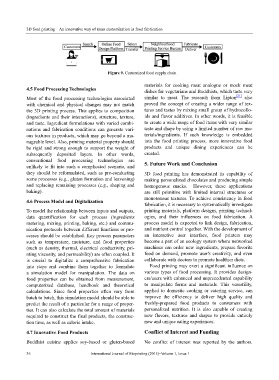
                                               Figure 9. Customized food supply chain

                                                               materials for cooking  meat  analogue  or  mock  meat
            4.5 Food Processing Technologies                   dishes for vegetarians and Buddhists, which taste very
            Most  of  the  food  processing  technologies  associated   similar to  meat.  The research  from  Lipton [21]   also
            with  chemical and  physical changes may not  match   proved the concept of creating a wider range of tex-
            the 3D printing process. This applies to composition   tures and tastes by mixing small group of hydrocollo-
            (ingredients and their interactions), structure, texture,   ids and flavor additives. In other words, it is feasible
            and taste. Ingredient formulations with varied combi-  to create a wide range of food items with very similar
            nations and  fabrication  conditions can  generate vari-  taste and shape by using a limited number of raw ma-
            ous textures in products, which may go beyond a ma-  terials/ingredients.  If such  knowledge  is embedded
            nageable level. Also, printing material property should   into the food printing process, more innovative food
            be rigid and  strong enough to support the weight of   products  and unique  dining experiences  can  be
            subsequently deposited layers.  In other words,    created.
            conventional food processing technologies are
            unlikely to fit into such a complicated scenario, and   5. Future Work and Conclusion
            they should be reformulated,  such  as pre-conducting   3D food printing has demonstrated its capability  of
            some processes (e.g., gluten formation and leavening)   making personalized chocolates and producing simple
            and replacing remaining processes (e.g., shaping and   homogenous snacks.   However,  these applications
            baking).                                           are still  primitive with  limited  internal  structures  or
                                                               monotonous textures. To  achieve consistency in food
            4.6 Process Model and Digitalization
                                                               fabrication, it is necessary to systematically investigate
            To model the relationship between inputs and outputs,   printing materials, platform designs, printing technol-
            data quantification for  each  process (ingredients   ogies,  and  their  influences on food fabrication.  A
            metering, mixing, printing, baking, etc.) and commu-  process model is expected to link design, fabrication,
            nication protocols between different functions or pro-  and nutrient control together. With the development of
            cesses should be established. Key process parameters   an  interactive user interface,  food  printers may
            such as temperature, moisture, and food properties   become a part of an ecology system where networked
            (such as density, thermal, electrical conductivity, pri-  machines can order new ingredients, prepare favorite
            nting viscosity, and permeability) are often coupled. It   food on demand, promote  user's creativity, and even
            is  crucial  to  digitalize  a  comprehensive  fabrication   collaborate with doctors to promote healthier diets.
            into steps and combine them together to formulate      Food printing may exert a significant influence on
            a simulation  model for  manipulation. The data  on     various types of food processing. It provides design-
            food  properties can  be obtained  from measurement,   ers/users with enhanced and unprecedented capability
            computerized  database,  handbook  and  theoretical     to  manipulate forms and  materials.  This versatility,
            calculations.  Since  food  properties often vary  from   applied to domestic cooking or catering service, can
            batch to batch, this simulation model should be able to   improve  the  efficiency to  deliver high  quality  and
            predict the result of a particular for a range of proper-  freshly-prepared food  products to consumers  with
            ties. It can also calculate the total amount of materials   personalized  nutrition.  It  is also capable of creating
            required to construct the final products, the construc-  new flavors, textures and shapes  to provide  entirely
            tion time, as well as calorie intake.              new and unique eating experiences.
            4.7 Innovative Food Products                       Conflict of Interest and Funding

            Buddhist cuisine  applies  soy-based or gluten-based   No  conflict of interest  was  reported by the authors.

            36                          International Journal of Bioprinting (2015)–Volume 1, Issue 1

