


Page 37 - IJB-1-1
P. 37
Jie Sun, Zhuo  Peng, Liangkun Yan, et al

            pre-patterning  food  items at multiple  layers of   is a summary of current commercial 3DP applications
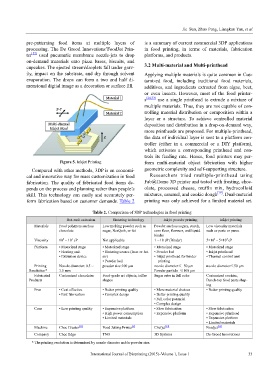
            processing. The De Grood Innovations’FoodJet Prin-  in  food  printing,  in  terms of  materials,  fabrication
            ter [32]   used pneumatic  membrane  nozzle-jets  to  drop   platforms, and products.
            on-demand  materials onto  pizza bases, biscuits,  and
            cupcakes. The ejected stream/droplets fall under grav-  3.2 Multi-material and Multi-printhead
            ity, impact on the substrate, and dry through solvent   Applying multiple materials is quite common in Cus-
            evaporation.  The  drops  can  form  a  two  and  half  di-  tomized  food,  including traditional food  materials,
            mensional digital image as a decoration or surface fill.   additives, and ingredients extracted from algae, beet,

                                                               or even insects.  However, most of  the  food printer-
                                                               s [24,33]  use a single printhead to extrude a mixture of
                                                               multiple materials. Thus, they are not capable of con-
                                                               trolling material distribution or composition within a
                                                               layer or  a structure.  To  achieve controlled  material
                                                               deposition and distribution in a drop-on-demand way,
                                                               more printheads are proposed. For multiple-printhead,
                                                               the data of individual layer is sent to a platform con-
                                                               troller (either in  a  commercial or  a  DIY platform),
                                                               which activates a corresponding printhead and con-
                                                               trols its feeding rate. Hence, food printers may per-
                          Figure 5. Inkjet Printing            form multi-material object fabrication  with  higher
               Compared with other methods, 3DP is an economi-  geometric complexity and self-supporting structure.
            cal and innovative way for mass customization in food   Researchers tried multiple-printhead using
            fabrication. The  quality  of  fabricated food  items  de-  Fab@Home 3D printer and tested with frosting, choc-
            pends on the process and planning rather than people’s   olate, processed cheese, muffin mix,  hydrocolloid
            skill.  This technology  can  easily and  accurately  per-  mixtures, caramel, and cookie dough [19] . Dual-material
            form fabrication based on customer demands. Table 2   printing was only achieved for a limited material set.


                                         Table 2. Comparison of 3DP technologies in food printing
                              Hot-melt extrusion   Sintering technology   Inkjet powder printing   Inkjet printing
                Materials   Food polymers such as   Low melting powder such as   Powder such as sugars, starch,   Low viscosity materials
                          chocolate          sugar, NesQuik, or fat   corn flour, flavours, and liquid   such as paste or puree
                                                                   binder
                                5
                                                                                            2
                                                                                                  3
                            3
                Viscosity   10  ~ 10  cP     Not applicable        1 ~ 10 cP (Binder)    5×10 ~ 5×10 cP
                Platform   • Motorized stage   • Motorized stage   • Motorized stage     • Motorized stage
                          • Heating unit     • Sintering source (laser or hot   • Powder bed   • Inkjet printhead
                          • Extrusion device   air)                • Inkjet printhead for binder   • Thermal control unit
                                             • Powder bed           printing
                Printing   Nozzle diameter: 0.5 ~   powder size:100 μm   nozzle diameter≤  50 μm   nozzle diameter≤50 μm
             Resolution*   1.5 mm                                  Powder particle  ≤100 μm
                Fabricated   Customized chocolates   Food-grade art objects, toffee   Sugar cube in full color   Customized cookies,
             Products                        shapes                                      Bench-top food paste shap-
                                                                                         ing
                Pros      • Cost effective   • Better printing quality   • More material choices   • Better printing quality
                          • Fast fabrication   • Complex design    • Better printing quality
                                                                   • Full color potential
                                                                   • Complex design
                Cons      • Low printing quality   • Expensive platform   • Slow fabrication   • Slow fabrication
                                             • High power consumption   • Expensive platform   • Expensive printhead
                                             • Limited materials                         • Expensive platform
                                                                                         • Limited materials
                Machine   Choc Creator [33]    Food Jetting Printer    Chefjet [34]      Foodjet [32]
                                                          [2]
                Company   Choc Edge          TNO                   3D Systems            De Grood Innovations
               * The printing resolution is determined by nozzle diameter and/or powder size.

                                        International Journal of Bioprinting (2015)–Volume 1, Issue 1      33

