


Page 34 - IJB-1-1
P. 34
3D food printing—An innovative way of mass customization in food fabrication

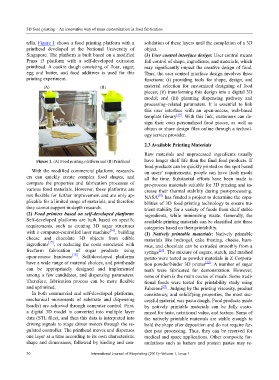
            tella. Figure 1 shows a food printing platform with a   solidation of these layers until the completion of a 3D
            printhead developed at  the  National University  of   object.
            Singapore. The platform is built based on a modified   (3) User control interface design: User control means
            Prusa i3 platform with  a self-developed extrusion   full control of shape, ingredients, and materials, which
            printhead. A cookie dough consisting of flour, sugar,   may significantly impact the creative design of food.
            egg and butter, and food additives  is used  for this   Thus, the user control interface design involves three
            printing experiment.                               functions:  (i) providing tools for  shape,  design, and

                    (A)                                   (B)   material selection for customized designing of food
                                                               pieces; (ii) transforming this design into a digital 3D
                                                               model;  and  (iii) planning  dispensing pathway and
                                                               processing–related  parameters.  It  is essential to  link
                                                               this  user  interface  with  an  open-access,  web-based
                                                               template library [19] . With this link, customers can de-
                                                               sign  their  own  personalized food pieces,  as well as
                                                               obtain or share design files online through a technol-
                                                               ogy service provider.

                                                               2.3 Available Printing Materials
                                                               Raw materials  and  unprocessed  ingredients usually
                 Figure 1. (A) Food printing platform and (B) Printhead   have longer shelf life than the final food products. If
                                                               food products can be quickly printed on the spot based
               With  the modified commercial platform, research-  on  users’ requirements,  people can  have fresh  meals
            ers can  quickly create complex food shapes, and   all the time.  Substantial efforts have been  made to
            compare  the properties and fabrication processes of   pre-process materials suitable for 3D printing and in-
            various food materials. However, these platforms are   crease their thermal stability  during post-processing.
            not flexible for further improvement and are only ap-  NASA [20]  has funded a project to determine the capa-
            plicable for a limited range of materials, and therefore   bilities of 3D food printing technology to ensure nu-
            they cannot support in-depth research.             trient stability for a variety of foods from shelf stable
            (2) Food printers based on self-developed platform:   ingredients,  while minimizing  waste.  Generally,  the
            Self-developed platforms are built based on specific   available printing materials can be classified into three
            requirements,  such  as  creating  3D  sugar  structures   categories based on their printability.
            with a computer-controlled laser machine [16] , building   (1)  Natively  printable materials:  Natively printable
            cheese and  chocolate 3D objects from edible       materials like hydrogel,  cake  frosting,  cheese,  hum-
            ingredients [17] , or reducing  the costs associated with   mus, and chocolate can be extruded smoothly from a
            freeform fabrication  of  sugar products using     syringe [21] . The mixture of sugars, starch, and mashed
            open-source hardware [18] .  Self-developed platforms   potato were tested as powder materials in Z Corpora-
            have a wide range of material choices, and printheads   tion powder/binder 3D printer [22] . A number of sugar
            can  be  appropriately  designed and implemented   teeth  were fabricated  for  demonstration. However,
            among  a few candidates, and  dispensing parameters.   none of them is the main course of meals. Some tradi-
            Therefore,  fabrication  process can be more flexible   tional  foods  were tested  for  printability  study using
            and optimized.                                     Fabaroni [23] . Judging by the printing viscosity, product
               In  both  commercial  and  self-developed  platforms,   consistency, and solidifying properties, the most suc-
            mechanical movements of  substrate  and dispensing   cessful material was pasta dough. Food products made
            head(s) are achieved through computer control. First,   by natively printable materials can  be fully  custo-
            a  digital 3D model  is  converted  into  multiple layer   mized for taste, nutritional value, and texture. Some of
            data (STL files), and then this data is interpreted into   the  natively printable materials are stable enough to
            driving signals to stage driver motors through the re-  hold the shape after deposition and do not require fur-
            gulated controller. The printhead moves and dispenses   ther  post  processing.  Thus, they  can be  reserved  for
            one layer at a time according to its own characteristic   medical and space applications. Other composite for-
            shape and dimensions, followed by binding and con-  mulations such as batters and protein pastes may re-

            30                          International Journal of Bioprinting (2015)–Volume 1, Issue 1

