


Page 33 - IJB-1-1
P. 33
Jie Sun, Zhuo Peng, Liangkun Yan, et al
instantly making personalized meals and replicating arm and created a fully-customized meal using normal
exciting food designs. The first generation of food food. Philips Food Creation Printer introduced food
printer concept designs and prototypes, designed 10 cartridges to create custom-designed food products [12] .
years ago, are now emerging into the public domain. An interactive graphical user interface was proposed
With a short history, a few research projects were to select ingredients, quantities, shapes, textures, and
conducted from concept designs to an in-depth re- other food properties. This idea is applicable to cus-
search on material extrusion and deposition. tomize any 3D food product. However, all of these
concept designs seem vastly unrealistic with no poten-
2.1 Conceptual Ideas tial of implementation.
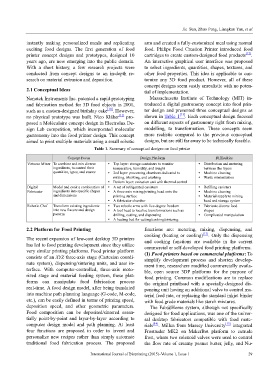
Nanotek Instruments Inc. patented a rapid prototyping Massachusetts Institute of Technology (MIT) in-
and fabrication method for 3D food objects in 2001, troduced a digital gastronomy concept into food prin-
such as a custom-designed birthday cake [10] . However, ter design and presented three conceptual designs as
no physical prototype was built. Nico Kläber [11] pro- shown in Table 1 [13] . Each conceptual design focused
posed a Moléculaire concept design in Electrolux De- on different aspects of gastronomy right from mixing,
sign Lab competition, which incorporated molecular modelling, to transformation. These concepts seem
gastronomy into the food printer design. This concept more realistic compared to the previous conceptual
aimed to print multiple materials using a small robotic designs, but are still far away to be technically feasible.
Table 1. Summary of conceptual designs on food printer
Concept Focus Design Platform Difficulties
Virtuoso Mixer To combine and mix diverse Top layer: storage containers to monitor Distribution and metering
ingredients, to control their temperature, humidity, and weight between the layers
quantities, types, and source 2nd layer: processing chambers dedicated to Machine cleaning
mixing, whisking, and crushing Waste minimization
Bottom layer: extrusion unit with thermal control
Digital Model and cook a combination of A set of refrigerated canisters Refilling canisters
Fabricator ingredients into specific shapes A three-axis mixing/printing head onto the Machine cleaning
and dimensions printing surface Material supply to mixing
A fabricator chamber head and storage system
Robotic Chef Transform existing ingredients Two robotic arms with five-degree freedom Fabricate diverse food
into new flavors and design A tool head to localize transformations such as shapes
patterns drilling, cutting, and dispensing Complicated manipulation
A heating bed for cutting/cooking/sintering
2.2 Platform for Food Printing functions are: metering, mixing, dispensing, and
cooking (heating or cooling) [13] . Only the dispensing
The recent expansion of low-cost desktop 3D printers and cooking functions are available in the current
has led to food printing development since they utilize commercial or self-developed food printing platforms.
very similar printing platforms. Food printer platform (1) Food printers based on commercial platforms: To
consists of an XYZ three-axis stage (Cartesian coordi- simplify development process and shorten develop-
nate system), dispensing/sintering units, and user in- ment time, researchers modified commercially availa-
terface. With computer-controlled, three-axis moto- ble, open source 3DP platforms for the purpose of
rized stage and material feeding system, these plat- food printing. Common modifications are to replace
forms can manipulate food fabrication process the original printhead with a specially-designed dis-
real-time. A food design model, after being translated pensing unit having an additional valve to control ma-
into machine path planning language (G-code, M-code, terial feed rate, or replacing the standard inkjet binder
etc.), can be easily defined in terms of printing speed, with food grade materials like starch mixtures.
deposition speed, and other geometric parameters. The Fab@Home system, although not specifically
Food composition can be deposited/sintered essen- designed for food applications, was one of the univer-
tially point-by-point and layer-by-layer according to sal desktop fabricators compatible with food mate-
computer design model and path planning. At least rials [14] . Millen from Massey University [15] integrated
four functions are proposed in order to invent and Frostruder MK2 on MakerBot platform to extrude
personalize new recipes rather than simply automate frost, where two solenoid valves were used to control
traditional food fabrication process. The proposed the flow rate of creamy peanut butter, jelly, and Nu-
International Journal of Bioprinting (2015)–Volume 1, Issue 1 29

