


Page 45 - IJB-1-1
P. 45
Makoto Nakamura, Tanveer  A.  Mir, Kenichi Arai,  et al.

            cation  in  a single  molecule,  are known  as excellent   and 1% penicillin and streptomycin (P/S), as well as
            bio-functional materials that prevent both  cell   D-glucose and essential saline.  SMCs were seeded
                                                                                                            5
            adhesion and protein adsorption [17,18] ,  and  are also   onto stripe patterned discs at a concentration of 7×10
            useful for bio-patterning [19,20] .  In  this work, zwitte-  cells  per one well  in 24-well plates and  cultured  in
            rionic polymers were prepared using 1-carboxy-N,N-   Dulbecco’s Modified Eagle Medium (DMEM, Gibco,
            dimethyl-N-(2’-methacryloyloxyethyl)methanaminium   USA) supplemented with 10% FBS and 1% P/S. The
            inner salt also known as carboxymethyl betaine (CMB)   cells were cultured at 37℃  with 5% CO 2 in an incu-
            was kindly  donated  from  Osaka Organic Chemical   bator and the medium was changed every two days.
            Industry, Kashiwara,  Japan,  and n-butylmethacrylate
            (BMA) obtained from Wako, Osaka, Japan, at the rate   2.3 Ethics Statement
            of (CMB/BMA = 29/71; MW = 193 kDa and MW/Mn        All animal experiments were performed according to a
            =1.92; 1 wt% ethanol solution),  and  utilized  as a   protocol approved by the  Committee on Ethics in
            surface patterning material. 1% CMB ethanol solution   Animal Experiments of the  University of Toyama,
            was  used  to  print  stripe  patterns  onto  plastic  culture   Japan.
            discs with  a custom-made inkjet 3D  Bioprinter [21–24]
            equipped  with an inkjet head  (IJHB-1000, MICRO-  2.4 Patterning of Cells and Transfer Printing
            JET Corporation, Nagano, Japan). The width of each   After  being seeded  and cultured  on  stripe  patterned
            printed  line was 200  µm with  an  interval width  be-  coated discs, the cells attached only to the CMB/BMA
            tween lines of 500 µm. After printing, the patterned   non-coated  areas,  with  linear patterned  CMs,  MBs,
            discs were dried and sterilized by UV irradiation be-  and SMCs were obtained. Next, we performed transfer
            fore being used in the experiments.                printing on day 9 for CMs, day 7 for MBs, and day 1

            2.2 Preparation of Muscle Cells                    for SMCs after seedings. In this procedure, culture
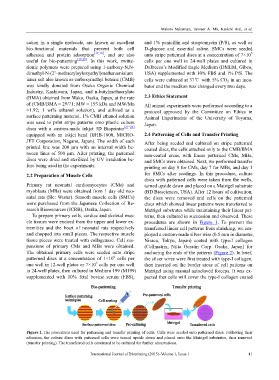
                                                               discs with patterned cells were taken from the wells,
            Primary  rat neonatal cardiomyocytes (CMs) and     turned upside down and placed on a Matrigel substrate
            myoblasts (MBs) were obtained from 1 day old neo-  (BD Biosciences, USA). After 12 hours of cultivation,
            natal rats (Slc: Wistar). Smooth muscle cells (SMCs)   the discs were removed  and  cells on  the patterned
            were purchased from the Japanese Collection of Re-  discs which showed linear patterns were transferred to
            search Bioresources (JCRB), Osaka, Japan.          Matrigel substrates while maintaining their linear pat-
               To prepare primary cells, cardiac and skeletal mus-  terns, then cultured in succession and observed. These
            cle tissues were excised from the upper and lower ex-  procedures  are shown in  Figure 1. To prevent the
            tremities  and  the heart of neonatal rats respectively   transferred linear cell patterns from shrinking, we em-
            and chopped into small pieces. The respective muscle   ployed a custom-made silver wire (0.5 mm in diameter,
            tissue pieces were treated with collagenase. Cell sus-  Niraco,  Tokyo,  Japan) coated with type-I collagen
            pensions of primary  CMs  and MBs were obtained.   (Cellmatrix, Nitta Geratin  Corp. Osaka, Japan)  for
            The obtained primary cells were seeded onto stripe   anchoring the ends of the patterns (Figure 2). In brief,
                                                 6
            patterned  discs at a concentration of 1×10   cells  per   the silver wires were first treated with type-I collagen,
                                          5
            one well in 12-well plates or 7×10  cells per one well   then inserted on the border areas of cell patterns on
            in 24-well plates, then cultured in Medium 199 (M199)   Matrigel using manual autoclaved forceps. It was ex-
            supplemented with 10% fetal bovine serum (FBS),    pected that cells will cover the type-I collagen coated


            Figure 1. The procedures used for patterning and transfer printing of cells. Cells were seeded onto patterned discs. Following their
            adhesion, the culture discs with patterned cells were turned upside down and placed onto the  Matrigel substrates, then removed
            (transfer printing). The transferred cells continued to be cultured for further observations.

                                        International Journal of Bioprinting (2015)–Volume 1, Issue 1      41

