


Page 49 - IJB-1-1
P. 49
Makoto Nakamura, Tanveer  A.  Mir, Kenichi Arai,  et al.


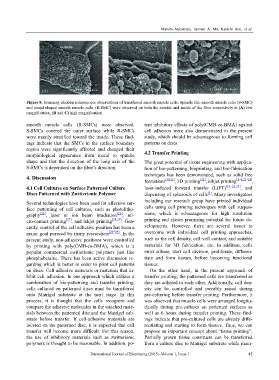
            Figure 8. Scanning electron microscopic observations of transferred smooth muscle cells. Spindle like smooth muscle cells (S-SMC)
            and round shaped smooth muscle cells (R-SMC) were observed on both the outside and inside of the fiber respectively at (A) low
            magnification, (B and C) high magnification.

            smooth  muscle cells (R-SMCs) were observed.       tent inhibitory effects of poly(CMB-co-BMA) against
            S-SMCs  covered the  outer  surface  while  R-SMCs   cell adhesion were also demonstrated in the present
            were mainly stratified toward the inside. These find-  study, which should be advantageous to forming cell
            ings indicate that the SMCs in the surface boundary   patterns on discs.
            region were significantly affected and changed their
            morphological  appearance from  round to spindle   4.2 Transfer Printing
            shape and that the direction of the  long axis of the   The great potential of tissue engineering with applica-
            S-SMCs is dependent on the fiber’s direction.      tion of bio-patterning, bioprinting, and bio-fabrication
                                                               techniques has been demonstrated,  such as  solid free
            4. Discussion
                                                               formations [30,31] , 3D printing [32] , inkjet printing [2–4,21–24] ,
            4.1 Cell Cultures on Surface Patterned Culture     laser-induced  forward  transfer (LIFT) [10–12,33] , and
            Discs Patterned with Zwitterionic Polymer          dispensing of spheroids of cells . Many investigators
                                                                                          [5]
            Several technologies have been used for effective sur-  including our research group have printed individual
            face patterning of cell cultures, such  as photolitho-  cells using  cell printing  techniques with  cell suspen-
            graphy [25] , laser or ion beam irradiation [26] , mi-  sions, which is advantageous for high resolution
            cro-contact printing [27] , and inkjet printing [28,29] . Gen-  printing and shows promising potential for future de-
            erally, control of the cell adhesive position has been a   velopments.  However,  there are several issues to
            major goal pursued by many researchers [26–29] . In the   overcome with individual  cell printing approaches,
            present study, non-adhesive positions were controlled   such as the cell density, cell–cell contact, and suitable
            by printing with poly(CMB-co-BMA),  which  is a    materials for 3D fabrication,  etc. In addition, cells
            popular commercial zwitterionic polymers just like   must  adhere,  start  cell  division,  proliferate,  differen-
            phosphobetaine. There has been active discussion re-  tiate and  form tissues,  before  becoming  functional
            garding which is better in order to print cell patterns   tissues.
            on discs: Cell adhesive materials or materials that in-  On the other hand, in the present approach of
            hibit cell adhesion. In our approach  which utilizes a   transfer printing, the patterned cells are transferred as
            combination of bio-patterning and transfer printing,   they are adhered to each other. Additionally, cell den-
            cells cultured  on  patterned  discs must be transferred   sity can be controlled and possibly raised during
            onto Matrigel substrate at the next stage. In this   pre-culturing before transfer printing. Furthermore, it
            process, it is thought that the cells recognize and   was observed that muscle cells were arranged longitu-
            compare the adhesive molecules in the attached mate-  dinally during pre-cultures on  patterned  surfaces  as
            rials between the patterned disc and the Matrigel sub-  well as 6 hours during transfer printing. These find-
            strate before transfer.  If cell-adhesive  materials are   ings indicate that pre-cultured cells are already diffe-
            located on the patterned disc, it is expected that cell   rentiating  and  starting  to  form  tissues.  Thus, we can
            transfer will become  more difficult.  For this reason,   propose an important concept about “tissue printing”.
            the use of inhibitory  materials  such  as zwitterionic   Partially grown  tissue constructs can  be transferred
            polymers is thought to be reasonable. In addition, po-  from a culture disc to Matrigel substrate while main-

                                        International Journal of Bioprinting (2015)–Volume 1, Issue 1      45

