


Page 8 - IJB-1-1
P. 8
Smart hydrogels for 3D bioprinting

            ser-based techniques. The latest progress in different   3. Bioprinting Techniques
            smart hydrogel systems  is  presented while the  chal-
            lenges of printing these hydrogel systems  are also   3D bioprinting can be generalized into three  main
            highlighted. Lastly, we present the future perspectives   categories based on the technique being used, namely,
            of smart hydrogels in 3D bioprinting.              (i)  Extrusion-based bioprinting techniques using me-
                                                               chanical  forces  to  extrude  the  material  through  an
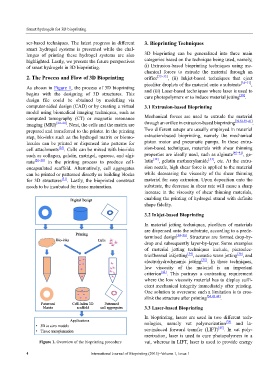
            2. The Process and Flow of 3D Bioprinting          orifice [32–33] ,  (ii) Inkjet-based  techniques that eject
                                                               picoliter droplets of the material onto a substrate [34–37] ,
            As shown in Figure 1, the process of 3D bioprinting
            begins with the  designing  of 3D structures.  This   and (iii) Laser-based techniques where laser is used to
                                                                                                       [38]
            design file could be  obtained by  modelling via   cure photopolymers or to induce material jetting  .
            computer-aided design (CAD) or by creating a virtual   3.1 Extrusion-based Bioprinting
            model using biomedical imaging techniques, such as
            computed tomography (CT) or magnetic resonance     Mechanical forces  are used to  extrude  the  material
                                                                                                     [32,33,39–41]
            imaging (MRI) [22–24] . Next, the cells and the matrix are   through an orifice in extrusion-based bioprinting  .
            prepared and transferred to the printer. In the printing   Two different setups are usually employed in material
            step, bio-inks such as the hydrogel matrix or biomo-  extrusion-based  bioprinting,  namely  the  mechanical
            lecules  can  be  printed  or  dispensed  into  patterns  for   piston motor and pneumatic pumps.  In these  extru-
            cell attachments [25] . Cells can be mixed with bio-inks   sion-based  techniques, materials with shear thinning
            such as collagen, gelatin, matrigel, agarose, and algi-  properties are ideally used, such as alginate [40–41] , ge-
            nate [26–30]   in the printing  process to produce cell-    latin [32] , gelatin methacrylamide [33] , etc. At the extru-
            encapsulated scaffold.  Alternatively,  cell aggregates   sion nozzle, high shear force is applied to the material
            can be printed or patterned directly as building blocks   while  decreasing  the viscosity of  the  shear  thinning
            for 3D structures [31] .  Lastly, the  bioprinted  construct   material for easy extrusion. Upon deposition onto the
            needs to be incubated for tissue maturation.       substrate, the decrease in shear rate will cause a sharp
                                                               increase  in  the  viscosity  of  shear  thinning  materials,

                                                               enabling the printing of hydrogel strand with definite
                                                               shape fidelity.
                                                               3.2 Inkjet-based Bioprinting

                                                               In  material  jetting  techniques,  picoliters  of  materials
                                                               are dispensed onto the substrate, according to a prede-
                                                               termined design [34–36] . Structures are formed drop-by-
                                                               drop and subsequently layer-by-layer. Some examples
                                                               of material jetting  techniques include, piezoelec-
                                                               tric/thermal inkjetting [34] , acoustic wave jetting [36] , and
                                                               electrohydrodynamic jetting [35] . In these  techniques,
                                                               low  viscosity of the material is an  important
                                                               criterion [42] .  This portrays  a contrasting requirement
                                                               where the low viscosity material has to display suffi-
                                                               cient mechanical integrity immediately after printing.
                                                               One solution to overcome such a limitation is to cros-
                                                               slink the structure after printing [34,43,44] .

                                                               3.3 Laser-based Bioprinting
                                                               In  bioprinting,  lasers  are  used  in  two  different  tech-
                                                               nologies,  namely  vat  polymerization [38]   and la-
                                                               ser-induced  forward transfer  (LIFT) [45] .  In  vat  poly-
                                                               merization,  laser  is  used to cure photopolymers in  a
                  Figure 1. Overview of the bioprinting procedure   vat, whereas in LIFT, laser is used to provide energy

            4                           International Journal of Bioprinting (2015)–Volume 1, Issue 1

