


Page 10 - IJB-1-1
P. 10
Smart hydrogels for 3D bioprinting


            4.1 pH Responsive Hydrogel                         has been reported. However, further adaptation of ge-
                                                               lation condition is required to develop a printable ke-
            pH responsive hydrogels are hydrogels that respond to   ratin formulation.
            environmental pH changes. They are made up of po-
            lymeric backbones that can accept and/or donate pro-
            tons during the change in pH [52,53] . Natural polymers
            such as collagen and keratin are pH-responsive.
               Collagen  is the  major component of extracellular
            matrix  protein.  It  consists  three  α  chains  which  can
            form  triple  helix.  Collagen  is a fibrous protein that
            provides tensile strength  to the  extracellular matrix
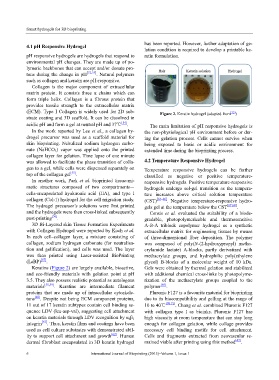
            (ECM). Type  I Collagen is widely used for 2D sub-       Figure 2. Keratin hydrogel (adapted from [13] )
            strate coating and 3D scaffold. It can be dissolved in
            acidic pH and form a gel at neutral pH and 37℃ [54] .   The main limitation of pH responsive hydrogels is
               In the work reported by Lee et al., a collagen hy-  the non-physiological pH environment before or dur-
            drogel precursor was used as a scaffold  material for   ing the gelation process. Cells cannot survive  when
            skin  bioprinting.  Nebulized  sodium hydrogen  carbo-  being  exposed to  basic  or acidic environment  for
            nate (NaHCO 3) vapor  was applied  onto the printed   extended time during the bioprinting process.
            collagen layer for gelation. Time lapse of one minute
            was allowed to facilitate the phase transition of colla-  4.2 Temperature Responsive Hydrogel
            gen to a gel, while cells were dispensed separately on   Temperature responsive hydrogels can  be further
            top of the collagen gel [55] .                     classified  as negative or positive  temperature-
               In another work,  Park  et al.  bioprinted  tissue-mi-  responsive hydrogels. Positive temperature-responsive
            metic structures composed  of two  compartments—   hydrogels undergo  sol-gel  transition  as the tempera-
            cells-encapsulated  hyaluronic acid  (HA),  and  type  I   ture increases  above critical  solution  temperature
            collagen (Col-1) hydrogel for the cell migration study.   (CST) [63–66] .  Negative  temperature-responsive  hydro-
            The hydrogel precursor’s solutions were first printed   gels gel at the temperature below the CST [67,68] .
            and the hydrogels were then cross-linked subsequently   Censis  et al.  evaluated  the  suitability of a biode-
            post-printing [56] .                               gradable,  photopolymerizable  and thermosensitive
               3D Bi-Layered skin Tissue Formation Experiments   A-B-A triblock copolymer hydrogel as a synthetic
            with Collagen Hydrogel were reported by Koch et al.   extracellular matrix for engineering tissues by means
            In  each  cell–collagen  layer, a mixture consisting  of   of  three-dimensional fiber  deposition. The polymer
            collagen, sodium hydrogen carbonate (for neutralisa-  was composed  of poly(N-(2-hydroxypropyl)  metha-
            tion  and  gelification), and  cells  was  used.  The  layer   crylamide  lactate) A-blocks, partly derivatized with
            was then printed using Laser-assisted  BioPrinting   methacrylate groups,  and hydrophilic poly(ethylene
            (LaBP) [57] .                                      glycol) B-blocks of a  molecular weight of 10  kDa.
               Keratins (Figure 2) are largely available, bioactive,   Gels were obtained by thermal gelation and stabilized
            and  eco-friendly  materials with  gelation  point  at  pH   with additional chemical cross-links by photopolyme-
            3.5. They also possess realistic potential as autologous   rization of the  methacrylate groups coupled to the
            materials [58,59] .  Keratins  are  intermediate filament   polymer [69] .
            proteins that  are  made up  of  intracellular cytoskele-  Pluronic F127 is a favourite material for bioprinting
            tons [60] . Despite not being ECM component proteins,   due to its biocompatibility and gelling at the range of
            11 out of 17 keratin subtypes contain cell binding se-  10 to 40℃ [70,71] . Chang et al. combined Pluronic F127
            quence LDV (leu-asp-val), suggesting cell attachment   with  collagen  type I as  bioinks.  Pluronic F127 has
            on keratin materials through LDV recognition by α 4β 1   high viscosity at room temperature that can stay long
            integrin [61] . Thus, keratin films and coatings have been   enough for collagen gelation, while collage provides
            used as cell culture substrates with demonstrated abil-  necessary cell binding  motifs for cell attachment.
            ity to support cell attachment and growth [62] . Human   Cells and  fragments extracted  from neovascular re-
            dermal fibroblast encapsulated in 3D keratin hydrogel   mained viable after printing using this method [47] .

            6                           International Journal of Bioprinting (2015)–Volume 1, Issue 1

