


Page 9 - IJB-1-1
P. 9
Shuai Wang, Jia Min Lee and Wai Yee Yeong

            to displace the materials via jetting. The material re-  (1)  Printablility:  The  hydrogels must be suitable
            quirements for  LIFT are similar to  the inkjet-based   for printer deposition with suitable viscosity, shear-
            bioprinting,  as  discussed  above.  For  vat  polymeriza-  thinning property, short response, transition time, and
            tion, the optical property of the material is important   suitable  sol-gel transition stimulus. Extrusion-based
            as it will affect the degree of crosslink in the printing   techniques usually require higher viscosity and
            process.                                           shear-thinning property [46,47] ; while inkjet-based tech-
                                                               niques require low viscosity material with very short
            3.4 Requirements of Hydrogel for Bioprinting       sol-gel response and transition time [48] .

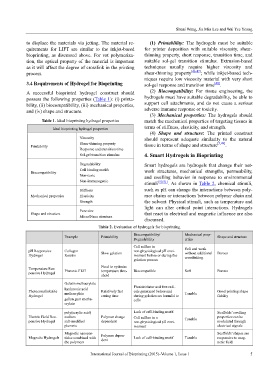
            A successful  bioprinted  hydrogel construct should   (2)  Biocompatibility:  For  tissue  engineering,  the
            possess the following properties (Table 1): (i) printa-  hydrogels must have suitable degradability, be able to
            bility, (ii) biocompatibility, (iii) mechanical properties,   support cell attachments, and do not cause a serious
            and (iv) shape and structure.                      adverse immune response or toxicity.
                                                                 (3)  Mechanical properties:  The hydrogels should
                   Table 1. Ideal bioprinting hydrogel properties   match the mechanical properties of targeting tissues in

                        Ideal bioprinting hydrogel properties   terms of stiffness, elasticity, and strength.
                                                                 (4)  Shape and  structure:  The printed  construct
                                   Viscosity                   should  represent adequate similarity to  the natural
                                   Shear-thinning property                                    [5,49]
              Printability                                     tissue in terms of shape and structure  .
                                   Response and transition time
                                   Sol-gel transition stimulus    4. Smart Hydrogels in Bioprinting

                                   Degradability               Smart hydrogels are hydrogels that change their net-
                                   Cell binding motifs
              Biocompatibility                                 work structures, mechanical strengths, permeability,
                                   Non-toxic                   and swelling behavior in response to environmental
                                   Non-immunogenic                  [50,51]
                                                               stimuli   . As shown in  Table 2,  chemical stimuli,
                                   Stiffness                   such as pH can change the interactions between poly-
              Mechanical properties   Elasticity               mer chains or interactions between polymer chain and
                                   Strength                    the solvent. Physical stimuli, such as temperature and
                                                               light can  alter critical point interactions.  Hydrogels
                                   Pore size
              Shape and structure                              that react to electrical and magnetic influence are also
                                   Micro/Nano structure        discussed.

                                           Table 2. Evaluation of hydrogels for bioprinting
                                                          Biocompatibility/     Mechanical prop-
                             Example        Printability                                      Shape and structure
                                                          Degradability         erties
                                                          Cell suffers in
             pH Responsive     Collagen                   non-physiological pH envi-  Soft and weak
             Hydrogel        Keratin        Slow gelation   ronment before or during the   without additional   Porous
                                                                                crosslinking
                                                          gelation process
                                            Need to optimize
             Temperature Res-  Pluronic F127   temperature thre-  Biocompatible   Soft        Porous
             ponsive Hydrogel
                                            shold
                             Gelatin methacrylate
                             hyaluronic acid              Photoinitiator and free radi-
             Photocrosslinkable   methacrylate   Relatively fast   cals generated before and   Tunable   Good printing shape
             Hydrogel                       curing time   during gelation are harmful to      fidelity
                             gellan gum metha-            cells
                             crylate
                             poly(acrylic acid)           Lack of cell-binding motif.         Scaffolds’ swelling
             Electric Field Res-  sodium    Polymer charge   Cell suffers in a                properties can be
             ponsive Hydrogel   salt-modified   dependent   non-physiological pH envi-  Tunable   modulated through
                             pluronic                     ronment                             electrical signals
                             Magnetic nanopar-                                                Scaffolds’ shapes are
             Magnetic Hydrogels   ticles combined with   Polymer depen-  Lack of cell-binding motif   Tunable   responsive to mag-
                                            dent
                             the polymers                                                     netic field


                                        International Journal of Bioprinting (2015)–Volume 1, Issue 1       5

