


Page 142 - IJB-10-2
P. 142
International Journal of Bioprinting                                dECM bioink for in vitro disease modeling


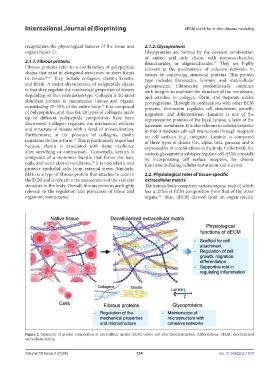
            recapitulates the physiological features of the tissue and   2.1.2. Glycoproteins
            organ (Figure 2).                                  Glycoproteins are formed by the covalent combination
                                                               of amino acid side chains with monosaccharides,
            2.1.1. Fibrous proteins                            disaccharides,  or  oligosaccharides.   They  are  highly
                                                                                            35
            Fibrous proteins refer to a combination of polypeptide   relevant to the maintenance of cohesive networks in
            chains that exist in elongated structures or sheet forms   tissues by connecting structural proteins. This protein
            in tissues. 30,31  They include collagens, elastin, keratin,   type includes fibronectin, laminin, and matricellular
            and fibrin. A major characteristic of polypeptide chains   glycoproteins. Fibronectin predominantly combines
            is that they regulate the mechanical properties of tissues   with integrin to maintain the structure of the membrane,
            depending on the combination type. Collagen is the most   and attaches to  collagen, fibrin,  and heparan sulfate
            abundant protein  in  mammalian tissues and  organs,   proteoglycans. Through its combination with other ECM
            constituting 25–35% of the entire body.  It is composed   proteins, fibronectin regulates cell attachment, growth,
                                            32
            of polypeptides, and thus far, 28 types of collagens made   migration, and differentiation. Laminin is one of the
            up of different polypeptide composition have been   representative proteins of the basal lamina, a layer of the
            discovered. Collagen regulates the mechanical stiffness   basement membrane. It is also relevant to cellular behavior
            and structure of tissues with a level of mineralization.   in that it mediates cell–cell interactions through receptors
            Furthermore, in the presence of collagens, elastin   on cell surfaces (e.g., integrin). Laminin is composed
            maintains its tissue form.  This is particularly important   of three types of chains (i.e., alpha, beta, gamma) and is
                                33
            because elastin is associated with tissue resilience   expressed in 14 combinations in the body. Collectively, the
            after stretching or contraction.  Conversely, keratin is   various glycoprotein subtypes regulate cell–ECM crosstalk
            composed of a monomer bundle that forms the hair,   by incorporating  cell  surface receptors, for  diverse
            nails, and outer skin of vertebrates.  It is viscoelastic and   functions including cellular maturation and survival.
                                        34
            protects epithelial cells from external stress. Similarly,
            fibrin is a type of fibrous protein that attaches to cells in   2.2. Physiological roles of tissue-specific
            the ECM and is related to the maintenance of the vascular   extracellular matrix
            structure in the body. Overall, fibrous proteins are highly   The human body comprises various organs, each of which
            relevant to the regulation and protection of tissue and   has a different ECM composition from that of the other
            organ microstructures.                             organs.  Thus, dECM derived from an organ-specific
                                                                     36


            Figure 2. Schematic of protein composition of extracellular matrix (ECM) before and after decellularization. Abbreviations: dECM, decellularized
            extracellular matrix.


            Volume 10 Issue 2 (2024)                       134                                doi: 10.36922/ijb.1970

