


Page 19 - IJB-10-2
P. 19
International Journal of Bioprinting                                         PEDOT/PSS-based sensors


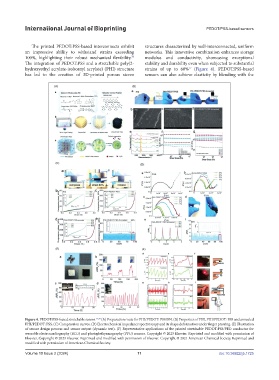
               The printed PEDOT:PSS-based interconnects exhibit   structures characterized by well-interconnected, uniform
            an impressive ability to withstand strains exceeding   networks. This innovative combination enhances storage
            100%,  highlighting  their  robust  mechanical flexibility.    modulus  and conductivity,  showcasing  exceptional
                                                         76
            The integration of PEDOT:PSS and a stretchable poly(2-  stability and durability even when subjected to substantial
            hydroxyethyl acrylate-isobornyl acrylate) (PHI) structure   strains  of  up  to  60%   (Figure  4).  PEDOT:PSS-based
                                                                                  77
            has led to the creation of 3D-printed porous stereo   sensors can also achieve elasticity by blending with the


            Figure 4. PEDOT:PSS-based stretchable sensor. 77,78  (A) Preparation route for PHI/PEDOT: PSS DN. (B) Properties of PHI, PHI/PEDOT: PSS and annealed
            PHI/PEDOT: PSS. (C) Compression curves. (D) Electrochemical impedance spectroscopy and its shape deformation under finger pressing. (E) Illustration
            of sensor design process and sensor output (dynamic test). (F) Representative applications of the printed stretchable PEDOT:PSS/PEO conductor for
            wearable electrocardiography (ECG) and photoplethysmography (PPG) sensors. Copyright © 2023 Elsevier. Reprinted and modified with permission of
            Elsevier. Copyright © 2023 Elsevier. Reprinted and modified with permission of Elsevier. Copyright © 2021 American Chemical Society. Reprinted and
            modified with permission of American Chemical Society.

            Volume 10 Issue 2 (2024)                        11                                doi: 10.36922/ijb.1725

