


Page 242 - IJB-10-2
P. 242
International Journal of Bioprinting                       G40T60@WNT5A promotes osteoblast differentiation


            2.20. Transwell, scratch assay, and tube           2.22. Double immunofluorescence
            formation assay                                    The cells were fixed with 4% paraformaldehyde at room
            First, the migration of UVECs was assessed through   temperature for 15 min, and then washed twice with PBS.
            Transwell experiments. UVECs, co-cultured and      The cells were permeabilized with 0.5% Triton X-100
            trypsinized, were resuspended and then seeded on the   (P0096, Beyotime, China) for 10 min. Then, the cells were
            apical chamber of 8.0 μm Transwell inserts (BDFalcon™,   incubated overnight at 4°C with primary antibodies: sheep
            USA) at a density of 2 × 10 /insert. The induced membrane   anti-OPN (ab11503, 1:200, Abcam, UK) and rabbit anti-
                                 5
            was placed in the sub-chamber. After 24 h, the cells were   RUNX2 (#12556, 1:6400, CST, USA). After washing the
            fixed with 4% paraformaldehyde for 30 min and then   slides 3 times with PBS, the slides were incubated with Alexa
            stained with 0.1% crystal violet. Imaging of migrating cells   Fluor  488-conjugated secondary antibody  (ab150129/
            was performed using a microscope (IX73, OLYMPUS).  ab150077, 1:200, Abcam, UK) for 1 h. Then, the slides were

               Scratch assay was used to detect the migration of   washed 3 times with PBS and stained with DAPI (10 μg/
            UVECs. UVECs were seeded at a density of 2 × 10  cells/  ml; D3571, Thermo Fisher, USA) at room temperature for
                                                     5
            well in a 12-well plate and allowed to grow until 100%   10 min. The slides were stored at 4°C and then observed
                                                                                                       59
            confluence. Scratch, measuring approximately 600 μm   using a fluorescent microscope (IMT-2, Olympus).
            in width, was made on monolayers after 3 h of nutrient   2.23. RT-qPCR
            deprivation. Cells were incubated at 37°C and 5% CO  with   Total cellular RNA was extracted using Trizol (Catalog #:
                                                      2
            different induced membranes (i.e., induced membranes   16096020, Invitrogen, USA). The purity and concentration
            were soaked in serum-free culture medium for 72 h) for 12   of the obtained RNA were assessed by measuring the
            h. Then, the cells were imaged using a microscope (IX73,   absorbance of the solution at 260 and 280 nm by means
            OLYMPUS). The relative closure degree of quantified   of spectrophotometry. The A /A  ratio of the sample
                                                                                           280
                                                                                       260
            scratches was measured using ImageJ software.      should be ≥1.8. To obtain cDNA, reverse transcription was
               The tube-forming ability of UVECs was also assessed.   performed using the  Reverse  Transcription Kit (Catalog
            After being thawed overnight on ice, the UVECs in a   number: 11483188001,  Roche,  Switzerland). Reaction
            48-well plate were added with 250  μl of Matrigel (BD   conditions were set as follows: 42°C for 15 min (reverse
            Biosciences,  USA)  and incubated  at  37°C  for  30 min   transcription reaction); 85°C for 5 s (reverse transcriptase
            to  allow  gel  formation.  The UVECs were inoculated  at   inactivation reaction). The reverse-transcribed cDNA was
            a concentration of 2.5 × 10 /cell in Matrigel and treated   diluted to 50 ng/μl for subsequent fluorescence quantitative
                                  4
            with different elution media. Subsequently, the cells were   polymerase chain reaction (PCR). PCR was performed
            incubated at 37°C in 5% CO  for 6 h. Then, the cells were   using the LightCycler 480 SYBR Green I Master under the
                                   2
            imaged using a microscope (IX73, OLYMPUS),  while   following conditions: initial denaturation at 95°C for 10 min,
                                                    55
            quantitative analysis was performed using ImageJ software.  followed by denaturation at 95°C for 15 s, annealing at 60°C
                                                               for 20 s, and extension at 72°C for 20 s, for a total of 40 cycles.
            2.21. Hematoxylin and eosin staining               With Gapdh as the internal reference, 2-ΔΔCt method was
            The extracted induced membrane was fixed with 4%   employed. 2-ΔΔCt represents the fold change in expression
            formaldehyde, and after 24 h of fixation, paraffin embedding   of the target gene in the experimental group compared to the
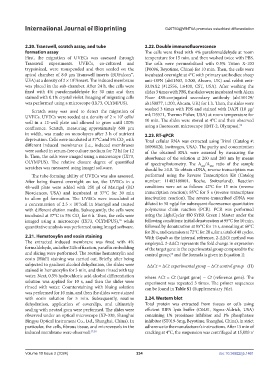
            and slicing were performed. The routine hematoxylin and   control group,  and the formula is given in Equation II:
                                                                          60
            eosin (H&E) staining was carried out. Briefly, after being
            subjected to gradient alcohol dehydration, the slides were     ΔΔCt = ΔCt experimental group − ΔCt control group  (II)
            stained in hematoxylin for 3 min, and then rinsed with tap
            water. Next, 0.5% hydrochloric acid alcohol differentiation   where ΔCt = Ct (target gene) − Ct (reference gene). The
            solution was applied for 10 s, and then the slides were   experiment was repeated 3 times. The primer sequences
            rinsed with  water.  Counterstaining  with  bluing  solution   can be found in Table S1 (Supplementary File).
            was performed for 10 min, and then the slides were stained
            with eosin solution for 5 min. Subsequently, routine   2.24. Western blot
            dehydration, application of coverslips, and ultimately   Total protein was extracted from tissues or cells using
            sealing with neutral gum were performed. The slides were   efficient RIPA lysis buffer (C0481, Sigma-Aldrich, USA)
            observed under an optical microscope (XP-330, Shanghai   containing 1% proteinase inhibitor and 1% phosphatase
            Bingyu Optical Instrument Co., Ltd., Shanghai, China). In   inhibitor (ST019-5mg, Beyotime, Shanghai, China), in strict
            particular, the cells, fibrous tissue, and microvessels in the   adherence to the manufacturer’s instructions. After 15 min of
            induced membrane were observed. 57,58              cracking at 4°C, the suspension was centrifuged at 15,000 r/


            Volume 10 Issue 2 (2024)                       234                                doi: 10.36922/ijb.1461

