


Page 447 - IJB-10-2
P. 447
International Journal of Bioprinting                                 3D-printed silicon nitride-PEEK implants


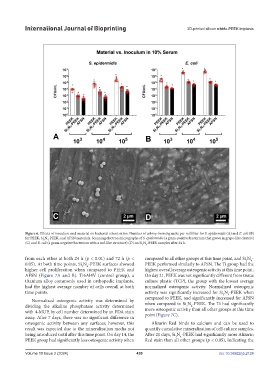
            Figure 6. Effects of inoculum and material on bacterial colonization. Number of colony-forming units per milliliter for S. epidermidis (A) and E. coli (B)
            for PEEK, Si N -PEEK, and AFSN materials. Scanning electron micrographs of S. epidermidis (a gram-positive bacterium that grows in grape-like clusters)
                     4
                    3
            (C) and E. coli (a gram-negative bacterium with a rod-like structure) (D) on Si N -PEEK samples after 24 h.
                                                               4
                                                              3
            from each other at both 24 h (p < 0.01) and 72 h (p <   compared to all other groups at this time point, and Si N -
                                                                                                            4
                                                                                                          3
            0.05). At both time points, Si N -PEEK surfaces showed   PEEK performed similarly to AFSN. The Ti group had the
                                    3
                                      4
            higher cell proliferation when compared to PEEK and   highest overall average osteogenic activity at this time point.
            AFSN (Figure 7A and  B). Ti6Al4V (control group), a   On day 21, PEEK was not significantly different from tissue
            titanium alloy commonly used in orthopedic implants,   culture plastic (TCP), the group with the lowest average
            had the highest average number of cells overall at both   normalized osteogenic activity. Normalized osteogenic
            time points.                                       activity was significantly increased for Si N -PEEK when
                                                                                                3
                                                                                                  4
                                                               compared to PEEK, and significantly increased for AFSN
               Normalized  osteogenic  activity  was  determined  by
            dividing the alkaline phosphatase activity determined   when compared to Si N -PEEK. The Ti had significantly
                                                                                   4
                                                                                3
                                                               more osteogenic activity than all other groups at this time
            with 4-MUP, by cell number determined by an FDA stain   point (Figure 7C).
            assay. After 7 days, there was no significant difference in
            osteogenic activity between any surfaces; however, this   Alizarin Red binds to calcium and can be used to
            result was expected due to the mineralization media not   quantify cumulative mineralization of cell culture samples.
            being introduced until after this time point. On day 14, the   After 21 days, Si N -PEEK had significantly more Alizarin
                                                                            3
                                                                              4
            PEEK group had significantly less osteogenic activity when   Red stain than all other groups (p < 0.05), indicating the
            Volume 10 Issue 2 (2024)                       439                                doi: 10.36922/ijb.2124

