


Page 215 - IJB-10-3
P. 215
International Journal of Bioprinting                                 Sr on GO enhances PLLA/PGA scaffold


            in Figure 6a. As time elapsed, the cells expanded and were   cells/mm , respectively, on day 5, which were much higher
                                                                      2
            accompanied by a large number of prominent pseudopodia   than that on day 1. LG/GPSr1.5 exhibited a higher BMSCs
            on both scaffolds. 72,73  The quantitative analysis of relative cell   density than the LG scaffold when cultured for the same
            adhesion area was carried out, and the results are presented   period of time. This might be due to the fact that the GPSr
            in Figure 6b. As time prolonged, the relative cell adhesion   in the LG/GPSr1.5 scaffold increased surface roughness of
            area on the surface of the LG and LG/GPSr1.5 scaffolds   the scaffold, providing more adhesion sites for BMSCs and
            gradually increased and reached 31.68% and 40.72% on day   thus promoting cell adhesion and growth. 76,77  The results
            5, respectively. The LG/GPSr1.5 scaffold exhibited a larger   of living/dead cell staining and cell adhesion showed that
            relative cell adhesion area than the LG scaffold at each period.  the LG/GPSr1.5 scaffold possessed good cytocompatibility.
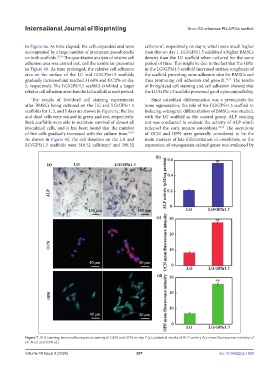
               The results of live/dead cell staining experiments   Since osteoblast differentiation was a prerequisite for
            after BMSCs being cultured on the LG and LG/GPSr1.5   bone regeneration, the role of the LG/GPSr1.5 scaffold in
            scaffolds for 1, 3, and 5 days are shown in Figure 6c; the live   inducing osteogenic differentiation of BMSCs was studied,
            and dead cells were stained in green and red, respectively.   with the LG scaffold as the control group. ALP staining
            Both scaffolds were able to maintain survival of almost all   test was conducted to evaluate the activity of ALP which
            inoculated cells, and it has been found that the number   reflected the early mature osteoblasts. 78,79  The secretions
            of live cells gradually increased with the culture time. 74,75    of OCN and OPN were generally considered to be the
            As shown in Figure 6d, the cell densities on the LA and   main markers of late differentiation of osteoblasts, so the
            LG/GPSr1.5 scaffolds were 310.52 cells/mm  and 398.32   expression of osteogenesis-related genes was evaluated by
                                                2


            Figure 7. ALP staining, immunofluorescence staining of OCN and OPN on day 7 (a); statistical results of ALP activity (b); mean fluorescence intensity of
            OCN (c) and OPN (d).

            Volume 10 Issue 3 (2024)                       207                                doi: 10.36922/ijb.1829

