


Page 547 - IJB-10-3
P. 547
International Journal of Bioprinting                               Engineered 3D-printed PVA vascular grafts


             (iii)  LDH release assay: Following the incubation period,   Plasma-free hemoglobin and total blood hemoglobin
                 50 µL of the supernatant in each well was collected   (TBH)  were  determined  according  to  ASTM F756-13,
                 and added to a clean well in a new 96-well plate   using Drabkin’s reagent. To adjust the TBH concentration
                 to measure LDH released by cells. To measure the   to 10 ± 1 mg/mL, whole pooled blood was diluted with
                 released  LDH  following  the  cells’  exposure  to  the   Ca/Mg-free  PBS.  Following  this  step,  the  diluted  TBH
                 vascular graft, the CyQUANT LDH Cytotoxicity   concentration was verified.
                 Assay (Invitrogen, USA) was used. Samples were   The samples were prepared according to the guidelines,
                 prepared according to the producer’s specifications,   and the corresponding quantities were suspended in
                 and the absorbance was measured at 490 nm. For   7  mL  PBS.  Negative  control  was  prepared using  40%
                 non-adherent  U937  monocyte  cells,  the  sample   poly(ethylene glycol)  (PEG) 8000  and  positive  control
                 was  removed  from  the  well,  and  the  cells  and  cell   using 10% Tween-100 in PBS. Approximately 1 mL of
                 culture were collected in Eppendorf tubes to be   diluted blood was added to each sample and then incubated
                 centrifuged at 400 rpm for 5 min. The supernatant   at 37°C for 3 h with mixing every 30 min.
                 was collected, and LDH release was measured.
                 For  all  quantitative  measurements,  blank  samples   Following the incubation period, tubes containing
                 were  prepared  (extract/medium  without  cells  and   the samples were centrifuged at 700 rpm for 15 min, and
                 dilutions). The blank absorbance was subtracted   the supernatant was carefully collected. The supernatant
                 from the cell samples’ absorbance to eliminate any   of each sample was diluted to 1:1 with Drabkin’s reagent
                 possible interferences.                       and incubated for 15 min. Thereafter, the absorbance of
                                                               the samples was measured at 540 nm. The percentage of
               All experiments were performed in triplicate. Cell   hemolysis for each sample was determined as follows:
            viability and LDH release were calculated relative to
            negative control samples (untreated cells). Data are
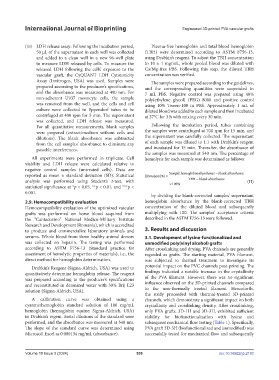
                                                                                             −
            reported as mean ± standard deviation (SD). Statistical   Hemolysis(%) =  Sample hemoglobin absorbance blankabsorbance  ×100%
            analysis was performed using Student’s  t-test, with   −             TBH −− blankabsorbance    (II)
                                         Sample hemoglobin absorbance blankabsorbance
                               Hemolysis(%) =
            statistical significance at *p < 0.05, **p < 0.01, and ***p <   ×100%
                                                 TBH −− blankabsorbance
            0.001.
                                                                  by dividing the blank-corrected samples’ supernatant
            2.9. Hemocompatibility evaluation                  hemoglobin absorbance by the blank-corrected TBH
            Hemocompatibility evaluation of the optimized vascular   concentration of the diluted blood and subsequently
            grafts was performed on horse blood acquired from   multiplying with 100. The samples’ acceptance criteria
            the  “Cantacuzino”  National Medico-Military Institute   described in the ASTM F756-13 were followed.
            Research and Development (Romania), which is accredited
            to produce and commercialize laboratory animals and   3. Results and discussion
            serums. Whole blood from three healthy animal donors   3.1. Development of lysine-functionalized and
            was collected on heparin. The testing was performed   unmodified poly(vinyl alcohol) grafts
            according to ASTM F756-13 (Standard practice for   After crosslinking and drying, PVA channels are generally
            assessment of hemolytic properties of materials), i.e., the   regarded as grafts. The starting material, PVA filament,
            direct method for hemoglobin determination.        was subjected to thermal treatment to investigate its
               Drabkin’s Reagent (Sigma-Aldrich, USA) was used to   potential impact on the PVC channels post-printing. The
            quantitatively determine hemoglobin release. The reagent   findings indicated a notable increase in the crystallinity
            was prepared according to the producer’s specifications   of the PVA filament. However, there was no significant
            and reconstituted in deionized water with 30% Brij L23   influence observed on the 3D-printed channels compared
            solution (Sigma-Aldrich, USA).                     to the non-thermally treated filament. Henceforth,
                                                               the study proceeded with thermal-treated 3D-printed
               A calibration curve was obtained using a        channels, which demonstrate a significant impact on both
            cyanmethemoglobin standard solution of 180 mg/mL   crystallinity and crosslinking density. After crosslinking,
            hemoglobin (hemoglobin equine; Sigma-Aldrich, USA)   only PVA grafts, 3D-1H and 3D-3H, exhibited sufficient
            in Drabkin’s regent. Serial dilutions of the standard were   stability for biofunctionalization with lysine and
            performed, and the absorbance was measured at 540 nm.   subsequent mechanical flow testing (Table 1). Specifically,
            The slope of the standard curve was determined using   PVA graft 3D-3H (biofunctionalized and unmodified) was
            Microsoft Excel as 0.000134 mg/mL (absorbance).    successfully tested for mechanical flow and subsequently


            Volume 10 Issue 3 (2024)                       539                                doi: 10.36922/ijb.2193

