


Page 548 - IJB-10-3
P. 548
International Journal of Bioprinting                               Engineered 3D-printed PVA vascular grafts


            Table 1. Essential insights into the polyvinyl alcohol (PVA) grafts
             Sample                                            Stability
                           Microchannel development       Chemical modification and lyophilization  Flow testing
             0D-3H               Not stable                         Not stable                    Not stable
             1D-3H                Stable                            Not stable                    Not stable
             3D-3H                Stable                              Stable                       Stable
             0D-24H              Not stable                         Not stable                    Not stable
             1D-24H              Not stable                         Not stable                    Not stable
             3D-24H              Not stable                         Not stable                    Not stable
            Abbreviations: D: Duration of thermal treatment (days); H: Duration of crosslinking (hours).

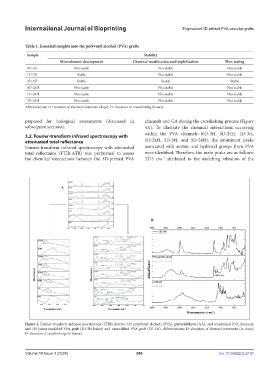
            prepared for biological assessments (discussed in   channels and GA during the crosslinking process (Figure
            subsequent sections).                              4A). To illustrate the chemical interactions occurring
                                                               within the PVA channels (0D-3H, 0D-24H, 1D-3H,
            3.2. Fourier-transform infrared spectroscopy with
            attenuated total reflectance                       1D-24H, 3D-3H, and 3D-24H), the prominent peaks
            Fourier-transform infrared spectroscopy with attenuated   associated with acetate and hydroxyl groups from PVA
            total reflectance (FTIR-ATR) was performed to assess   were identified. Therefore, the main peaks are as follows:
            the chemical interactions between the 3D-printed PVA   3375 cm  attributed to the stretching vibration of the
                                                                      −1


            Figure 4. Fourier-transform infrared spectroscopy (FTIR) spectra: (A) poly(vinyl alcohol) (PVA), glutaraldehyde (GA), and crosslinked PVA channels;
            and (B) lysine-modified PVA graft (3D-3H-lysine) and unmodified PVA graft (3D-3H). Abbreviations: D: duration of thermal treatment (in days);
            H: duration of crosslinking (in hours).


            Volume 10 Issue 3 (2024)                       540                                doi: 10.36922/ijb.2193

