


Page 552 - IJB-10-3
P. 552
International Journal of Bioprinting                               Engineered 3D-printed PVA vascular grafts


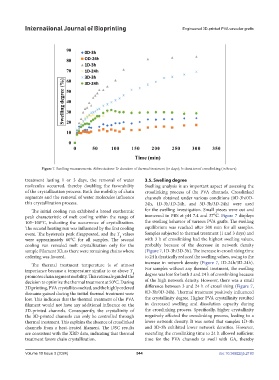
                   Figure 7. Swelling measurements. Abbreviations: D: duration of thermal treatment (in days); h: duration of crosslinking (in hours).

            treatment lasting 1 or 3 days, the removal of water   3.5. Swelling degree
            molecules occurred, thereby doubling the favorability   Swelling analysis is an important aspect of assessing the
            of the crystallization process. Both the mobility of chain   crosslinking process of the PVA channels. Crosslinked
            segments and the removal of water molecules influence   channels obtained under various conditions (0D-3h/0D-
            this crystallization process.                      24h, 1D-3h/1D-24h, and 3D-3h/3D-24h)  were used
               The initial cooling run exhibited a broad exothermic   for the swelling investigation. Small pieces were cut and
            peak characteristic of melt cooling within the range of   immersed in PBS at pH 7.4 and 37℃. Figure 7 displays
            105–108°C, indicating the occurrence of crystallization.   the swelling behavior of various PVA grafts. The swelling
            The second heating run was influenced by the first cooling   equilibrium was reached after 300 min for all samples.
            event. The hysteresis peak disappeared, and the T  values   Samples subjected to thermal treatment (1 and 3 days) and
                                                    g
            were approximately 60℃ for all samples. The second   with 3 h of crosslinking had the highest swelling values,
            cooling run revealed melt crystallization only for the   probably  because  of  the  decrease  in  network  density
            sample Filament 3D, as there were remaining chains where   (Figure 7, 1D-3h/3D-3h). The increase in crosslinking time
            ordering was favored.                              to 24 h drastically reduced the swelling values, owing to the
                                                               increase in network density (Figure 7, 1D-24h/3D-24h).
               The  thermal  treatment temperature  is of  utmost
            importance because a temperature similar to or above T    For samples without any thermal treatment, the swelling
                                                          g
            promotes chain segment mobility. This rationale guided the   degree was low for both 3 and 24 h of crosslinking because
            decision to optimize the thermal treatment at 50°C. During   of the high network density. However, there was a small
            3D printing, PVA crystallites melted, and the highly ordered   difference between 3 and 24 h of crosslinking (Figure 7,
            domains gained during the initial thermal treatment were   0D-3h/0D-24h). Thermal treatment positively influenced
            lost. This indicates that the thermal treatment of the PVA   the crystallinity degree. Higher PVA crystallinity resulted
            filament would not have any additional influence on the   in decreased swelling and dissolution capacity during
            3D-printed channels. Consequently, the crystallinity of   the crosslinking process. Specifically, higher crystallinity
            the 3D-printed channels can only be controlled through   negatively affected the crosslinking process, leading to a
            thermal treatment. This explains the absence of crosslinked   lower network density. It was noted that samples 1D-3h
            channels from a heat-treated filament. The DSC results   and 3D-3h exhibited lower network densities. However,
            are consistent with the XRD data, indicating that thermal   extending the crosslinking time to 24 h allowed sufficient
            treatment favors chain crystallization.            time for the PVA channels to swell with GA, thereby


            Volume 10 Issue 3 (2024)                       544                                doi: 10.36922/ijb.2193

