


Page 599 - IJB-10-3
P. 599
International Journal of Bioprinting                                  Five-axis printer for hybrid 3D scaffolds


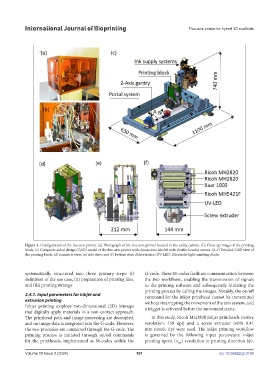
            Figure 1. Configuration of the five-axis printer. (a) Photograph of the five-axis printer housed in the safety cabinet. (b) Close-up image of the printing
            block. (c) Computer-aided design (CAD) model of the five-axis printer with dimensions labeled with double-headed arrows. (d–f) Detailed CAD view of
            the printing block: (d) isometric view; (e) side view; and (f) bottom view. Abbreviation: UV-LED: Ultraviolet light-emitting diode.


            systematically structured into three primary steps:  (i)   G-code. These M-codes facilitate communication between
            definition of the use case, (ii) preparation of printing files,   the two workflows, enabling the transmission of signals
            and (iii) printing strategy.                       to the printing software and subsequently initiating the
                                                               printing process by calling the images. Notably, the on/off
            2.4.1. Input parameters for inkjet and             command for the inkjet printhead cannot be transmitted
            extrusion printing                                 without interrupting the movement of the axis system, and
            Inkjet printing employs two-dimensional (2D) bitmaps   a trigger is activated before the movement starts.
            that digitally apply materials in a non-contact approach.
            The printhead path and image processing are decoupled,   In this study, Ricoh MH2820 inkjet printheads (native
            and no image data is integrated into the G-code. However,   resolution: 150 dpi) and a screw extruder (with 0.41
            the two processes are connected through the G-code. The   mm nozzle tip) were used. The inkjet printing workflow
            printing process is initiated through on/off commands   is governed by the following input parameters: inkjet
            for the printheads, implemented as M-codes within the   printing speed (ν ) resolution in printing direction (ϕ),
                                                                             IJP ,
            Volume 10 Issue 3 (2024)                       591                                doi: 10.36922/ijb.3189

