


Page 603 - IJB-10-3
P. 603
International Journal of Bioprinting                                  Five-axis printer for hybrid 3D scaffolds


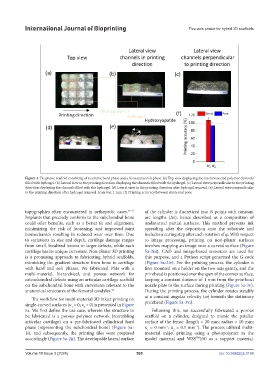
            Figure 4. Tri-phasic scaffold consisting of a ceramic hard phase and a bi-material soft phase. (a) Top view displaying the interconnected polymer channels
            filled with hydrogel. (b) Lateral view in the printing direction displaying the channels filled with the hydrogel. (c) Lateral view perpendicular to the printing
            direction displaying the channels filled with the hydrogel. (d) Lateral view in the printing direction after hydrogel removal. (e) Lateral view perpendicular
            to the printing direction after hydrogel removal. Scale bar: 1 mm. (f) Printing accuracy between struts and pore.


            topographies  often  encountered  in  orthopedic  cases. 39-41    of the cylinder is discretized into N points with constant
            Implants that precisely conform to the subchondral bone   arc lengths (∆s), hence described as a composition of
            could offer benefits, such as a better fit and alignment,   undistorted partial surfaces. This method prevents ink
            minimizing the risk of loosening, and improved joint   spreading after the deposition onto the substrate and
            biomechanics  resulting  in  reduced  wear  over  time.  Due   includes a curing step after each rotation of φ. With respect
            to variations in size and depth, cartilage damage ranges   to image processing, printing on non-planar surfaces
            from small, localized lesions to larger defects, while each   involves mapping an image onto a curved surface (Figure
            cartilage has its unique curvature. Non-planar 3D printing   5a-2iii). CAD and image-based resources are used for
            is a promising approach to fabricating  hybrid scaffolds,   this purpose, and a Python script generated the G-code
            mimicking the gradient structure from bone to cartilage   (Figure 5a-2iv). For the printing process, the cylinder is
            with hard and soft phases. We fabricated PSIs with a   first mounted on a holder on the two-axis gantry, and the
            multi-material, hierarchical, and porous network for   printhead is positioned over the apex of the convex surface,
            osteochondral defects using an articular cartilage scaffold   keeping a constant distance of 1 mm from the printhead
            on the subchondral bone with curvatures relevant to the   nozzle plate to the surface during printing (Figure 5a-3v).
            anatomical structures of the femoral condyles.     During the printing process, the cylinder rotates steadily
                                                 42
                                                               at a constant angular velocity (ω) beneath the stationary
               The workflow for multi-material 3D inkjet printing on
            single-curved surfaces (κ  = 0; κ  > 0) is presented in Figure    printhead (Figure 5a-3vi).
                                1
                                     2
            5a. We first define the use case, wherein the structure to   Following  this,  we  successfully fabricated a  porous
            be fabricated is a porous polymer network (resembling   scaffold on a cylinder, designed to mimic the patellar
            articular cartilage) on a pre-fabricated cylindrical hard   surface of the femur (length = 20 mm; radius = 10 mm;
            phase (representing the subchondral bone) (Figure 5a-  κ  = 0 mm ; κ  = 0.1 mm ). The process utilized multi-
                                                                        -1
                                                                                    -1
                                                                           2
                                                                1
            1i), and subsequently, the printing files were prepared   material inkjet printing using a photopolymer as the
            accordingly (Figure 5a-2ii). The developable lateral surface   model material and WSS 150 as a support material.
                                                                                     TM
            Volume 10 Issue 3 (2024)                       595                                doi: 10.36922/ijb.3189

