


Page 608 - IJB-10-3
P. 608
International Journal of Bioprinting                                  Five-axis printer for hybrid 3D scaffolds


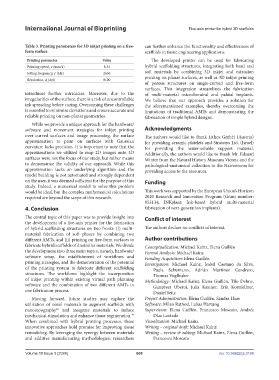
            Table 3. Printing parameters for 3D inkjet printing on a free-  can further enhance the functionality and effectiveness of
            form surface                                       scaffolds in tissue engineering applications.
             Printing parameter              Value                The developed printer can be used for fabricating
             Printing speed, ν (mm/s)        8.33              hybrid  scaffolding  structures, integrating  both  hard  and
             Jetting frequency, ƒ (Hz)       2656              soft materials by combining 3D inkjet and extrusion
             Resolution, ϕ (dpi)             8100              printing on planar surfaces, as well as 3D inkjet printing
                                                               of porous structures on single-curved and free-form
                                                               surfaces. This integration streamlines the fabrication
            introduces  further  intricacies.  Moreover, due  to  the   of  multi-material  osteochondral  and  palatal  implants.
            irregularities of the surface, there is a risk of uncontrollable   We believe that our approach provides a solution for
            ink spreading before curing. Overcoming these challenges   the  aforementioned  examples,  thereby  overcoming  the
            is essential to minimize deviations and ensure accurate and   limitations of traditional AMTs and demonstrating the
            reliable printing on non-planar geometries.        fabrication of simple hybrid designs.
               While we provide a unique approach for the hardware/
            software  and movement strategies  for inkjet printing   Acknowledgments
            over curved surfaces and image processing, the surface   The authors would like to thank Lithoz GmbH (Austria)
            approximation to  print  on  surfaces  with Gaussian   for providing ceramic platelets and Stratasys Ltd. (Israel)
            curvature lacks precision. It is important to note that the   for providing the water-soluble support material.
            approximations we utilized to map 2D images onto 3D   Additionally, the authors would like to thank Mr. Eduard
            surfaces were not the focus of our study, but rather means   Winter from the Natural History Museum Vienna and the
            to demonstrate the validity of our approach. While this   pathological-anatomical collection in the Narrenturm for
            approximation lacks an underlying algorithm and the   providing access to the resources.
            model building is not automated and strongly dependent
            on the user, it was deemed sufficient for the purpose of this   Funding
            study. Indeed, a numerical model to solve this problem
            would be ideal, but the complex mathematical calculations   This work was supported by the European Union’s Horizon
            required are beyond the scope of this research.    2020 Research and Innovation Program (Grant number:
                                                               953134; INKplant: Ink-based hybrid multi-material
            4. Conclusion                                      fabrication of next-generation implants).

            The central topic of this paper was to provide insight into   Conflict of interest
            the development of a five-axis printer for the fabrication
            of hybrid scaffolding structures on two fronts: (i) multi-  The authors declare no conflicts of interest.
            material fabrication of soft phases by combining two
            different AMTs, and (ii) printing on free-form surfaces to   Author contributions
            fabricate hybrid scaffolds of dissimilar materials. We divide   Conceptualization: Michael Kainz, Elena Guillén
            the development into three main topics, namely, hardware/  Formal Analysis: Michael Kainz
            software  setup, the  establishment  of  workflows  and   Funding Acquisition: Elena Guillén
            printing strategies, and the demonstration of the potential   Investigation:  Michael Kainz, Isabel Caetano da Silva,
            of the printing system to fabricate different scaffolding   Paula Schumann, Adrián Martínez Cendrero,
            structures. The workflows highlight the incorporation   Thomas Voglhuber
            of inkjet printing within existing virtual path planning   Methodology: Michael Kainz, Elena Guillén, Tilo Dehne,
            software  and  the  combination  of  two  different  AMTs  in   Gunpreet Oberoi, Julia Kastner, Erik Kornfellner,
            one fabrication process.                              Daniel Seitz
               Moving forward, future studies may explore the   Project Administration: Elena Guillén, Sandra Haas
            utilization of novel materials to augment scaffolds with   Software: Milan Rathod, Lukas Hartung
            nanotopography   and  integrate  materials  to  induce   Supervision:  Elena  Guillén,  Francesco  Moscato,  Andrés
                         48
            mechanical stimulation and enhance tissue regeneration.    Díaz Lantada
                                                         49
            When combined with hybrid printing processes, these   Visualization: Michael Kainz
            innovative approaches hold promise for improving tissue   Writing – original draft: Michael Kainz
            remodeling. By leveraging the synergy between materials   Writing – review & editing: Michael Kainz, Elena Guillén,
            and additive manufacturing methodologies, researchers   Francesco Moscato


            Volume 10 Issue 3 (2024)                       600                                doi: 10.36922/ijb.3189

