


Page 606 - IJB-10-3
P. 606
International Journal of Bioprinting                                  Five-axis printer for hybrid 3D scaffolds


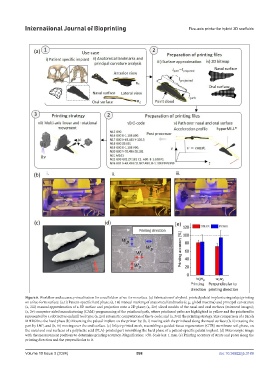
            Figure 6. Workflow and accuracy visualization for a scaffold on a free-form surface. (a) Fabrication of a hybrid-printed palatal implant using inkjet printing
            on a free-form surface: (a,1i) Patient-specific hard phase; (a, 1ii) manual marking of anatomical landmarks (e.g., global maxima) and principal curvatures;
            (a, 2iii) manual approximation of a 3D surface and projection onto a 2D plane; (a, 2iv) sliced models of the nasal and oral surfaces (mirrored images);
            (a, 2v) computer-aided manufacturing (CAM) programming of the printhead path, where printhead paths are highlighted in yellow and the printhead is
            represented by a subtractive endmill tool type; (a, 2vi) automatic computation of the G-code; and (a, 3vii) the printing strategy. Size comparison of a Ricoh
            MH2820 to the hard phase (b) Mounting the palatal implant on the printer by: (b, i) moving with the printhead along the nasal surface; (b, ii) rotating the
            part by 180°; and (b, iii) moving over the oral surface. (c) Inkjet-printed mesh, resembling a guided-tissue regeneration (GTR) membrane soft phase, on
            the nasal and oral surfaces of a polylactic acid (PLA)-printed part resembling the hard phase of a patient-specific palatal implant. (d) Microscopic image
            with the measurement positions to determine printing accuracy. Magnification: ×50. Scale bar: 1 mm. (e) Printing accuracy of struts and pores along the
            printing direction and the perpendicular to it.

            Volume 10 Issue 3 (2024)                       598                                doi: 10.36922/ijb.3189

