


Page 602 - IJB-10-3
P. 602
International Journal of Bioprinting                                  Five-axis printer for hybrid 3D scaffolds


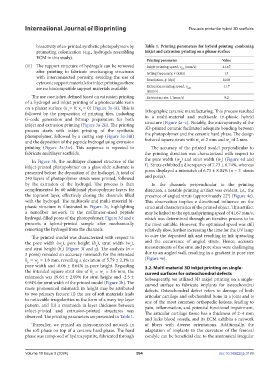
                 bioactivity of co-printed synthetic photopolymers by   Table 1. Printing parameters for hybrid printing combining
                 promoting colonization (e.g., hydrogels resembling   inkjet and extrusion printing on a planar surface
                 ECM in this study).
                                                                Printing parameter              Value
            (iii)  The support structure of hydrogels can be removed   Inkjet printing speed, ν  (mm/s)  41.67
                                                                              IJP
                 after printing to fabricate overhanging structures   Jetting frequency, ƒ (kHz)  13
                 with interconnected porosity, avoiding the use of   Resolution, ϕ (dpi)        8100
                 cytotoxic support materials for inkjet printing as there
                 are no biocompatible support materials available.  Extrusion printing speed, ν EXT   1.17
                                                                (mm/s)
               The use case is first defined based on extrusion printing   Extrusion rate, C (mm/s)  0.2
            of a hydrogel and inkjet printing of a photocurable resin
            on a planar surface (κ = 0; κ = 0) (Figure 3a-1i). This is   lithographic ceramic manufacturing. This process resulted
                              1
                                    2
            followed by the preparation of printing files, including   in a multi-material and multiscale tri-phasic hybrid
            G-code  generation  and bitmap preparation  for both
            inkjet and extrusion printing (Figure 3a-2ii). The printing   structure (Figure 4a–c). Notably, the microporosity of the
            process starts with inkjet printing of the synthetic   3D-printed ceramic facilitated adequate bonding between
            photopolymer, followed by a curing step (Figure 3a-3iii)   the photopolymer and the ceramic hard phase. The design
            and the deposition of the peptide hydrogel using extrusion   featured square struts with w  of 2 mm and w  of 2 mm.
                                                                                      s
                                                                                                   p
            printing (Figure 3a-3iv). This sequence is repeated to   The accuracy of the printed model perpendicular to
            fabricate multilayer scaffolds.                    the  printing  direction  was  characterized  with  respect  to
               In Figure 3b, the multilayer channel structure of the   the pore width (w ) and strut width (w ) (Figure 4d and
                                                                                               s
                                                                              p
            inkjet-printed photopolymer on a glass slide substrate is   f). Struts exhibited a discrepancy of 7.73 ± 6.74%, whereas
            presented before the deposition of the hydrogel. A total of   pores displayed a mismatch of 6.73 ± 8.04% (n = 3  struts
            240 layers of photopolymer struts were printed, followed   and pores).
            by the extrusion of the hydrogel. The process is then   In the channels perpendicular to the printing
            complemented by 60 additional photopolymer layers for   direction, a notable printing artifact was evident, i.e., the
            the topmost layer, effectively closing the channels filled   presence of angled struts (approximately 22°) (Figure 4e).
            with the hydrogel. The multiscale and multi-material bi-  This observation implies a directional influence on the
            phasic structure is illustrated in  Figure 3c, highlighting   structural characteristics of the printed object. This artifact
            a nanofiber network in the millimeter-sized peptide   may be linked to the optimal printing speed of 41.67 mm/s,
            hydrogel-filled pores of the photopolymer. Figure 3d and e    which was determined through an iterative process to be
            presents a hybrid-printed sample after mechanically   the most suitable. However, the optimized speed was still
            removing the hydrogel from the channels.           relatively slow, further increasing the time for the UV lamp
               The printed model was characterized with respect to   to cure the deposited ink and resulting in ink spreading
            the pore width (w ), pore height (h ), strut width (w ),   and the occurrence of angled struts. Hence, accurate
                                                         s
                                          p
                           p
            and strut height (h ) (Figure 3f and g). The analysis (n =   measurements of the strut and pore sizes were challenging
                           s
            3 pores) revealed an accuracy mismatch for the intended   due to an angled wall, resulting in a gradient in pore size
            h  = w  = 1.8 mm, revealing a deviation of 5.79 ± 2.1% in   (Figure 4e).
             p
                 p
            pore width and -6.06 ± 8.64% in pore height. Regarding   3.2. Multi-material 3D inkjet printing on single-
            the intended square strut size of  h  =  w  = 3.6 mm, the   curved surfaces for osteochondral defects
                                         s
                                             s
            mismatch was 19.64 ± 2.09% for strut height and -2.5 ±   Subsequently, we utilized 3D inkjet printing on a single-
            0.94% for strut width of the printed model (Figure 3h). The   curved surface to fabricate implants for osteochondral
            more pronounced mismatch in height may be attributed   defects. Osteochondral defect refers to damage of both
            to two primary factors: (i) the use of soft materials leads   articular cartilage and subchondral bone in a joint and is
            to noticeable irregularities in the form of a wavy top layer   one of the most common orthopedic lesions, leading to
            pattern, and (ii) a mismatch in layer thickness between   pain, inflammation, and potential functional impairment.
            inkjet-printed and extrusion-printed structures was   The articular cartilage tissue has a thickness of 2–4 mm
            observed. The printing parameters are presented in Table 1.  and lacks blood vessels, and its ECM exhibits a network
               Thereafter, we printed an interconnected network in   of fibers with diverse orientations. Additionally, the
            the soft phase on top of a ceramic hard phase. The hard   adaptation of implants to the curvature of the femoral
            phase was composed of hydroxyapatite, fabricated through   condyle can be beneficial due to the anatomical irregular


            Volume 10 Issue 3 (2024)                       594                                doi: 10.36922/ijb.3189

