


Page 600 - IJB-10-3
P. 600
International Journal of Bioprinting                                  Five-axis printer for hybrid 3D scaffolds


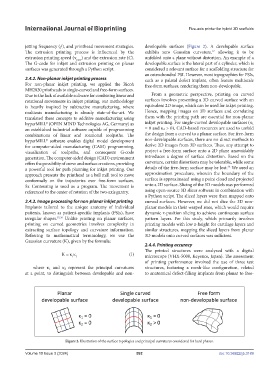
            jetting frequency (ƒ), and printhead movement strategies.   developable surfaces (Figure 2). A developable surface
            The extrusion printing process is influenced by the   exhibits zero Gaussian curvature,  allowing it to be
                                                                                           37
            extrusion printing speed (ν EXT ) and the extrusion rate (C).   unfolded onto a plane without distortion. An example of a
            The G-code for inkjet and extrusion printing on planar   developable surface is the lateral part of a cylinder, which is
            surfaces was generated through a Python script.    considered a relevant surface for a scaffolding structure for
                                                               an osteochondral PSI. However, most topographies for PSIs,
            2.4.2. Non-planar inkjet printing process          such as a palatal defect implant, often feature multiscale
            For non-planar inkjet printing, we applied the Ricoh   free-form surfaces, rendering them non-developable.
            MH2820 printheads to single-curved and free-form surfaces.
            Due to the lack of available software for combining linear and   From a geometric perspective, printing on curved
            rotational movements in inkjet printing, our methodology   surfaces involves presenting a 3D curved surface with an
            is heavily inspired by subtractive manufacturing, where   equivalent 2D image, which can be used for inkjet printing.
            multiaxis manufacturing is already state-of-the-art. We   Hence,  mapping  images  on  3D  surfaces  and  correlating
            translated these concepts to additive manufacturing using   them with the printing path are essential for non-planar
            hyperMILL® (OPEN MIND Technologies AG, Germany) as   inkjet printing. For single-curved developable surfaces (κ₁
            an established industrial software capable of programming   = 0 and κ₂ > 0), CAD-based resources are used to unfold
            combinations of linear and rotational toolpaths. The   the design from a curved to a planar surface. For free-form
            hyperMILL® software enables digital model development   non-developable surfaces, there are no direct methods to
            for computer-aided manufacturing (CAM) programming,   derive 2D images from 3D surfaces. Thus, any attempt to
            visualization of toolpaths, and consequent G-code   project a free-form surface onto a 2D plane unavoidably
            generation. The computer-aided design (CAD) environment   introduces a degree of surface distortion. Based on the
            offers the possibility of curve and surface creations, providing   curvature, certain distortions may be tolerable, while some
                                                                                                  38
            a powerful tool for path planning for inkjet printing. Our   details of the free-form surface may be lost.  We used an
            approach presents the printhead as a ball mill tool to move   approximation procedure, wherein the boundary of the
            conformally on the trajectories over free-form surfaces.   surface is approximated using a point cloud and projected
            5x Contouring is used as a program. The movement is   onto a 2D surface. Slicing of the 3D models was performed
            referenced to the center of rotation of the two-axis gantry.  using open-source 3D slicer software in combination with
                                                               a Python script. The sliced layers were then mapped onto
            2.4.3. Image processing for non-planar inkjet printing  curved surfaces. However, we did not slice the 3D non-
            Implants tailored to the unique anatomy of individual   planar models in their warped state, which would require
            patients, known as patient-specific implants (PSIs), have   dynamic z-position slicing to achieve continuous surface
            irregular shapes. 35,36  Unlike printing on planar surfaces,   pattern layers. For this study, which primarily involves
            printing on curved geometries involves complexity in   printing models with low z-height for cartilage layers and
            extracting  surface  topology  and  curvature  information.   similar structures, mapping the sliced layers from planar
            Referring to mathematical terminology, we use the   3D models onto curved surfaces was sufficient.
            Gaussian curvature (K), given by the formula:
                                                               2.4.4. Printing accuracy
                                                               The printed structures were analyzed with a digital
                           K = κ κ                      (I)    microscope (VHX-5000, Keyence, Japan). The assessment
                                1 2
                                                               of printing performance involved the use of three test
               where κ₁ and κ₂ represent the principal curvatures   structures, featuring a mesh-like configuration, related

            at  a  point, to  distinguish  between  developable  and  non-  to anatomical defect-filling implants from planar to free-


                             Figure 2. Illustration of the surface topologies and principal curvatures considered for hard phases.

            Volume 10 Issue 3 (2024)                       592                                doi: 10.36922/ijb.3189

