


Page 55 - IJB-4-2
P. 55
Tan C, et al.

           observed for 10%–12.5% due to low viscosity. Sample   different food systems. High-methoxyl (HM) pectins
           prints are shown in Figure 2.                       form strong gel networks when heated in the presence of
            Potato starch proved to be a good candidate in this   sugars and acids. This is because the low pH protonates
           case as it undergoes a well-known process called    the carboxylate groups of the HM pectin, causing less
           gelatinization. When the starch and lemon juice mixture   ionic repulsion between polymer chains, ultimately
           was cooked in steam for 20 minutes at about 86 °C, the   resulting in formation of a gel network. The sugar, being
           starch granules first became swollen due to uptake of   hygroscopic, promotes this network formation as it is
           water up to the point of rupturing. Once ruptured, the   able to trap free water molecules in the food system.
           amylose and amylopectin were released into the mixture   Thus, HM pectin is used widely in preparation of jams
           which caused significant increase in viscosity. When the   or jellies. Low-methoxyl (LM) pectin on the other hand,
           system was subsequently cooled to room temperature,   forms gel networks in the presence of calcium ions
                                                                  2+
           a stable gel network was formed. One problem with   (Ca ) in adherence to the egg-box model. Deprotonated
           using starch as a gelling agent is that it requires a   carboxylate groups on the pectin chain, bearing a
                                                                                                        2+
           relatively high concentration in order to achieve similar   negative charge, attract positively charged Ca  ions,
           effectiveness as the other hydrocolloids.           which are then surrounded by galacturonate residues to
                                                               form junction zones, resulting in gelling. In this study,
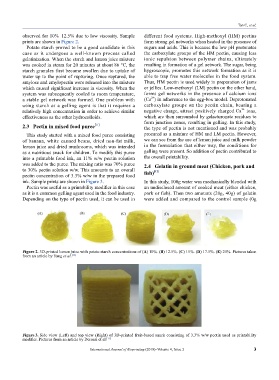
           2.3  Pectin in mixed food puree [11]                the type of pectin is not mentioned and was probably
            This study started with a mixed food puree consisting   procured as a mixture of HM and LM pectin. However,
           of banana, white canned beans, dried non-fat milk,   we can see from the use of lemon juice and milk powder
           lemon juice and dried mushrooms, which was intended   in the formulation that either way, the conditions for
           as a nutritious snack for children. To modify this puree   gelling were present. So addition of pectin contributed to
           into a printable food ink, an 11% w/w pectin solution   the overall printability.
           was added to the puree. The mixing ratio was 70% puree   2.4  Gelatin in ground meat (chicken, pork and
           to 30% pectin solution w/w. This amounts to an overall   fish) [12]
           pectin concentration of 3.3% w/w in the prepared food
           ink. Sample prints are shown in Figure 3.           In this study, 100g water was mechanically blended with
            Pectin was useful as a printability modifier in this case   an undisclosed amount of cooked meat (either chicken,
           as it is a common gelling agent used in the food industry.   pork or fish). Then two amounts (20g, 40g) of gelatin
           Depending on the type of pectin used, it can be used in   were added and compared to the control sample (0g


           Figure 2. 3D-printed lemon juice with potato starch concentrations of (A) 10%. (B) 12.5%. (c) 15%. (D) 17.5%. (e) 20%. Pictures taken
           from an article by Yang et al. [10]


           Figure 3. Side view (Left) and top view (Right) of 3D-printed fruit-based snack consisting of 3.3% w/w pectin used as printability
           modifier. Pictures from an article by Derossi et al. [11]

                                       International Journal of Bioprinting (2018)–Volume 4, Issue 2         3

