


Page 10 - IJB-10-4
P. 10
International Journal of Bioprinting                                       PAI for 3D bioprinted constructs


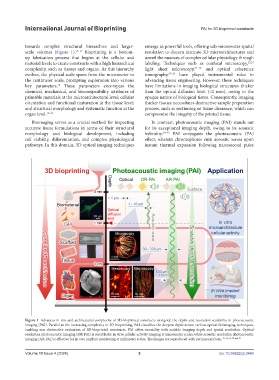
            towards complex structural hierarchies and larger-  emerge as powerful tools, offering sub-micrometer spatial
            scale volumes (Figure 1). 15–17  Bioprinting is a bottom-  resolution to discern intricate 3D microarchitectures and
            up fabrication process that begins at the cellular and   unveil the nuances of complex cellular physiology through
            material levels to create constructs with a high hierarchical   labeling. Techniques such as confocal microscopy, 22,23
            complexity, such as tissues and organs. As this hierarchy   light sheet microscopy, 24–26  and optical coherence
            evolves, the physical scale spans from the micrometer to   tomography, 27–29  have played instrumental roles in
            the centimeter scale, prompting exploration into various   advancing tissue engineering. However, these techniques
            key parameters.  These parameters encompass the    have limitations in imaging biological structures thicker
                          18
            chemical, mechanical, and biocompatibility attributes of   than the optical diffusion limit (<1 mm), owing to the
            printable materials at the microarchitectural level; cellular   opaque nature of biological tissue. Consequently, imaging
            orientation and functional maturation at the tissue level;   thicker tissues necessitates destructive sample preparation
            and structural morphology and systematic function at the   process, such as sectioning or tissue clearance, which can
            organ level. 19–21                                 compromise the integrity of the printed tissue.
               Bioimaging serves as a crucial method for inspecting   In contrast, photoacoustic imaging (PAI) stands out
            accurate tissue formulations in terms of their structural   for its exceptional imaging depth, owing to its acoustic
            morphology and biological  development,  including   hybridity. 30–35   PAI conjugates the photoacoustic  (PA)
            cell viability, differentiation, and complex physiological   effect, wherein chromophores emit acoustic waves upon
            pathways. In this domain, 3D optical imaging techniques   instant thermal expansion following nanosecond pulse


            Figure 1. Advances in size and architectural complexity of 3D-bioprinted constructs alongside the depth and resolution scalability in photoacoustic
            imaging (PAI). Parallel to the increasing complexity in 3D bioprinting, PAI visualizes the deepest depth across various optical bioimaging techniques,
            enabling non-destructive evaluation of 3D-bioprinted constructs. PAI offers versatility with scalable imaging depth and spatial resolution. Optical
            resolution photoacoustic imaging (OR-PAI) is suitable for in vitro cellular activity imaging at micrometer scales, while acoustic resolution photoacoustic
            imaging (AR-PAI) is effective for in vivo implant monitoring at millimeter scales. The images are reproduced with permission from.  19, 21, 45, 50, and 59


            Volume 10 Issue 4 (2024)                        2                                 doi: 10.36922/ijb.3448

