


Page 146 - IJB-10-4
P. 146
International Journal of Bioprinting                                 3D printing innovations against infection


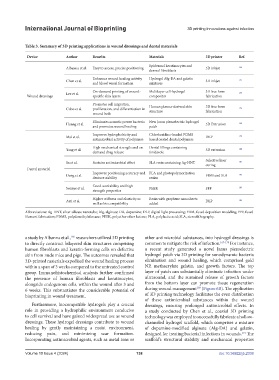
            Table 3. Summary of 3D printing applications in wound dressings and dental materials
             Device          Author      Benefits                Materials               3D printer    Ref.

                                                                 Epidermal keratinocytes and
                             Albanna et al.  Easy to access, precise positioning         3D inkjet     166
                                                                 dermal fibroblasts
                                         Enhances wound healing activity   Hydrogel Alg-DA and gelatin
                             Chen et al.                                                 3D inkjet     171
                                         and blood vessel formation  mixtures
                                         On-demand printing of wound-  Multilayer cell-hydrogel   3D free form
                             Lee et al.                                                                175
             Wound dressings             specific skin layers    composites              fabrication
                                         Promotes cell migration,
                             Cubo et al.  proliferation, and differentiation in   Human plasma-derived skin   3D free form   176
                                                                 structure
                                                                                         fabrication
                                         wound beds
                                         Eliminates acoustic power bacteria  New Janus piezoelectric hydrogel
                             Huang et al.                                                3D Extrusion   169
                                         and promotes wound healing  patch
                                         Improves hydrophobicity and   Chlorhexidine-loaded PDMS
                             Mai et al.                                                  DLP           179
                                         antimicrobial activity of polymers  based coated dental polymers
                                         High mechanical strength and on-  Dental fillings containing
                             Yang et al.                                                 3D extrusion   180
                                         demand drug release     tinidazole
                                                                                         Selective laser
                             Sa et al.   Sustains antimicrobial effect  SLA resin containing Ag-HNT    181
                                                                                         curing
             Dental material
                             Deng et al.  Improves positioning accuracy and  PLA and photopolymerization   FDM and SLA   182
                                         denture stability       resins
                                         Good workability and high
                             Sonaye et al.                       PEEK                    FFF           183
                                         strength properties
                                         Higher stiffness and elasticity as   Resin with graphene nanosheets
                             Aati et al.                                                 DLP           184
                                         well as biocompatibility  added
            Abbreviations: Ag-HNT, silver silicate nanotube; Alg, alginate; DA, dopamine; DLP, digital light processing; FDM, fused deposition modeling; FFF, fused
            filament fabrication; PDMS, polydimethylsiloxane; PEEK, polyether ether ketone; PLA, polylactic acid; SLA, stereolithography.


            a study by Albanna et al.,  researchers utilized 3D printing   other antimicrobial substances, into hydrogel dressings is
                               166
            to directly construct bilayered skin structures comprising   common to mitigate the risk of infection. 167-170  For instance,
            human fibroblasts and keratin-forming cells on defective   a recent study generated a novel Janus piezoelectric
            skin from nude mice and pigs. The outcomes revealed that   hydrogel patch via 3D printing for sonodynamic bacteria
            3D-printed materials expedited the wound healing process   elimination and wound healing, which comprised gold
            within a span of 3 weeks compared to the untreated control   NP, methacrylate gelatin, and growth factors. The top
            group. Immunohistochemical analysis further confirmed   layer of patch can substantially eliminate infection under
            the presence of human fibroblasts and keratinocytes,   ultrasound, and the sustained release of growth factors
            alongside endogenous cells, within the wound after 3 and   from the bottom layer can promote tissue regeneration
                                                                                     169
            6 weeks. This substantiates the considerable potential of   during wound management  (Figure 6B). The application
            bioprinting in wound treatment.                    of 3D printing technology facilitates the even distribution
                                                               of  these  antimicrobial  substances  within  the  wound
               Furthermore, biocompatible hydrogels play a crucial   dressings, ensuring prolonged antimicrobial effects. In
            role  in  providing  a hydrophilic  environment  conducive   a study conducted by Chen et al., coaxial 3D printing
            to cell survival and have gained widespread use as wound   technology was employed to successfully fabricate a hollow-
            dressings. These hydrogel dressings contribute to wound   channeled hydrogel scaffold, which comprises a mixture
            healing by gently maintaining a moist environment,   of dopamine-modified alginate (Alg-DA) and gelatin,
            reducing  pain,  and  minimizing  scar  formation.   designed for treating bacterial infections in wounds.  The
                                                                                                        171
            Incorporating antimicrobial agents, such as metal ions or   scaffold’s structural stability and mechanical properties

            Volume 10 Issue 4 (2024)                       138                                doi: 10.36922/ijb.2338

