


Page 176 - IJB-10-4
P. 176
International Journal of Bioprinting                                    Printing collagen type IV membrane


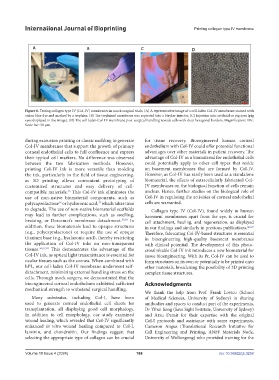
            Figure 6. Testing collagen type IV (Col-IV) membranes in mock surgical trials. (A) A representative image of a cell-laden Col-IV membrane stained with
            vision blue dye and marked by a trephine. (B) The trephined membrane was aspirated into a Stryker injector. (C) Injection into artificial or pig eyes (pig
            eyes displayed in the image). (D) The cell-laden Col-IV membrane post-surgical handling reveals cells with clear hexagonal borders. Magnification: 10×.
            Scale bar: 50 µm.


            during extrusion printing or classic molding to generate   for tissue recovery. Bioengineered human corneal
            Col-IV membranes that support the growth of primary   endothelium with Col-IV could offer potential functional
            corneal endothelial cells to full confluence and express   advantages over other materials in patient recovery. The
            their typical cell markers. No difference was observed   advantage of Col-IV as a biomaterial for endothelial cells
            between the two fabrication methods. However,      could  potentially  apply  to  other cell  types  that  reside
            printing Col-IV ink is more versatile than molding   on basement membranes that are formed by Col-IV.
            the ink, particularly in the field of tissue engineering,   However, as Col-IV has rarely been used as a standalone
            as 3D printing allows convenient prototyping of    biomaterial, the effects of extracellularly fabricated Col-
            customized  structures  and  easy  delivery  of  cell-  IV membranes on the biological function of cells remain
            compatible materials.  This Col-IV ink eliminates the   unclear. Hence, further studies on the biological role of
                              35
            use of non-native biomaterial components, such as   Col-IV in regulating the activities of corneal endothelial
                                           37
                          36
            polycaprolactone  or hyaluronic acid,  which takes time   cells are warranted.
            to degrade. The use of non-native biomaterial scaffolds   Collagen type IV (Col-IV), found widely in human
            may lead to further complications, such as swelling,   basement membranes apart from the eye, is crucial for
            bruising, or Descemet’s membrane detachment. 38,39  In   cell attachment, healing, and regeneration, as displayed
            addition, these biomaterials lead to opaque structures   in our findings and similarly in previous publications. 4,5,27
            (e.g., polycaprolactone) or require the use of opaque   Therefore, fabricating Col-IV-based structures is essential
            titanium base (e.g., hyaluronic acid), thereby restricting   in bioengineering  high-quality basement membranes
            the application of Col-IV inks on non-transparent   with clinical potential. The development of this photo-
            tissues. 36,37,40  This demonstrates the advantage of the   crosslinkable Col-IV ink introduces a new biomaterial for
            Col-IV ink, as optical light transmittance is essential for   tissue bioengineering. With its Pr, Col-IV can be used to
            ocular tissues such as the cornea. When combined with   form structures on its own or potentially to be printed onto
            hPL, our cell-laden Col-IV membrane underwent self-  other materials, broadening the possibility of 3D printing
            detachment, minimizing external handling stress on the   complex tissue structures.
            cells. Through mock surgery, we demonstrated that the
            bioengineered corneal endothelium exhibited sufficient   Acknowledgments
            mechanical strength to withstand surgical handling.
                                                               We thank the help from Prof. Frank Lovicu (School
               Many substrates, including Col-I, have been     of Medical Sciences, University of Sydney) in sharing
            used to generate corneal endothelial cell sheets for   antibodies and spaces to conduct part of the experiments,
            transplantation, all displaying good cell morphology.   Dr Yihui Song (Save Sight Institute, University of Sydney)
            In addition to cell morphology, our study examined   and Arzu Demir for their expertise with the original
            wound healing, which revealed that Col-IV significantly   Col-I protocols and assistance with some experiments,
            enhanced  in  vitro wound healing compared to Col-I,   Cameron Angus (Translational Research Initiative for
            laminin, and chondroitin. Our findings suggest that   Cell Engineering and Printing, ANFF Materials Node,
            selecting the appropriate type of collagen can be crucial   University of Wollongong) who provided training for the


            Volume 10 Issue 4 (2024)                       168                                doi: 10.36922/ijb.3258

