


Page 516 - IJB-10-4
P. 516
International Journal of Bioprinting                                   3D-printed variable stiffness scaffolds


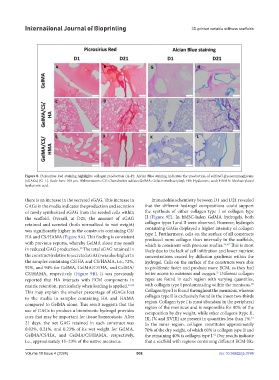
            Figure 8. Picrosirius Red staining highlights collagen production (A–F); Alcian Blue staining indicates the production of sulfated glycosaminoglycans
            (sGAGs) (G–L). Scale bars: 100 µm. Abbreviations: CS: Chondroitin sulfate; GelMA: Gelatin methacryloyl; HA: Hyaluronic acid; HAMA: Methacrylated
            hyaluronic acid.

            there is an increase in the secreted sGAG. This increase in   Immunohistochemistry between D1 and D21 revealed
            GAGs in the media indicates the production and secretion   that the different hydrogel compositions could support
            of newly synthesized sGAG from the seeded cells within   the synthesis of either  collagen type I or collagen type
            the scaffold. Overall, at D21, the amount of sGAG   II (Figure 9E). In hMSC-laden GelMA hydrogels, both
            retained  and  secreted  (both  normalized  to  wet  weight)   collagen types I and II were observed. However, hydrogels
            was significantly higher in the constructs containing CS/  containing GAGs displayed a higher intensity of collagen
                                                               type I. Furthermore, cells on the surface of all constructs
            HA and CS/HAMA (Figure 9A). This finding is consistent   produced more collagen than internally in the scaffolds,
            with previous reports, whereby GelMA alone may result   which is consistent with previous studies. 25,59  This is most
            in reduced GAG production.  The total sGAG retained in   likely due to the lack of cell infiltration and lower nutrient
                                   25
            the construct (relative to secreted sGAG) was also higher in   concentrations caused by diffusion gradients within the
            the samples containing CS/HA and CS/HAMA, i.e., 72%,   hydrogel. Cells on the surface of the constructs were able
            92%, and 94% for GelMA, GelMA/CS/HA, and GelMA/    to proliferate faster and produce more ECM, as they had
            CS/HAMA, respectively (Figure 9B). It was previously   better access to nutrients and oxygen.  Different collagen
                                                                                             25
            reported that HA interacts with ECM components in   types are found in each region with varying quantities,
                                                                                                            60
            matrix retention, particularly when loading is applied. 16,58    with collagen type I predominating within the meniscus.
            This may explain the smaller percentage of sGAGs lost   Collagen type I is found throughout the meniscus, whereas
            to the media in samples containing HA and HAMA     collagen type II is exclusively found in the inner two-thirds
            compared to GelMA alone. This result suggests that the   region. Collagen type I is most abundant in the peripheral
            use of GAGs to produce a biomimetic hydrogel provides   region of the meniscus and is responsible for 90% of the
                                                               composition by dry weight, while other collagens (type II,
            cues that may be important for tissue homeostasis. After   III, IV, and XVIII) are present in quantities less than 1%.
                                                                                                            61
            21 days, the net GAG retained in each construct was   In the inner region, collagen constitutes approximately
            0.02%, 0.21%, and 0.23% of its wet weight for GelMA,   70% of the dry weight, of which 60% is collagen type II and
            GelMA/CS/HA, and GelMA/CS/HAMA, respectively,      the remaining 40% is collagen type I.  Our results indicate
                                                                                            62
            i.e., approximately 15–23% of the native meniscus.   that a scaffold with regions containing different ECM-like

            Volume 10 Issue 4 (2024)                       508                                doi: 10.36922/ijb.3784

