Page 268 - IJB-10-5
P. 268

International Journal of Bioprinting                                A TPMS framework for complete dentures


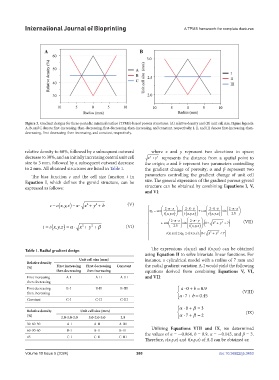
            Figure 3. Gradient designs for three-periodic minimal surface (TPMS)-based porous structures: (A) relative density and (B) unit cell size. Figure legends:
            A, B, and C denote first-increasing-then-decreasing, first-decreasing-then-increasing, and constant, respectively; I, II, and III denote first-increasing-then-
            decreasing, first-decreasing-then-increasing, and constant, respectively.


            relative density to 60%, followed by a subsequent outward   where  x and  y represent two directions in space;
            decrease to 30%, and an initially increasing central unit cell   x +  y  represents the distance from a spatial point to
                                                                    2
                                                                 2
            size to 3 mm, followed by a subsequent outward decrease   the origin; a and b represent two parameters controlling
            to 2 mm. All obtained structures are listed in Table 1.  the gradient change of porosity;  α and  β represent two
               The bias function  c and the cell size function  t in   parameters controlling the gradient change of unit cell
            Equation I, which defines the gyroid structure, can be   size. The general expression of the gradient porous gyroid
            expressed as follows:                              structure can be obtained by combining Equations I, V,
                                                               and VI:

                      c = (       a  x +  y +  b       (V)      
                         c x,y,z) =⋅
                                          2
                                      2
                                                                                                    ⋅⋅ 
                                                                 ϕ = cos  2  π ⋅⋅x   sin  2  π ⋅⋅ y    + cos   π ⋅ 2  ⋅ ⋅ y   sin  2 π  z  
                                                                      
                                                                               
                                                                                                  
                                                                  G
                                                                        ( tx,y,z )        ( tx,y,z )       ( tx,y,z )     25 .  
                                                                
                                                                                       
                                                                           ⋅⋅ 
                                                                     + cos  2 π  z  sin   2⋅⋅ ⋅π y   (  < x 2  + y 2  < 7 )    (VII)
                                                                                        , 0
                                        2
                                    2
                      t x,y,z) = α
                   t = (         ⋅  x +  y + β         (VI)               25 .        ( tx,y,z )   
                                                                                     (          )
                                                                                           2 2
                                                                      −cx,y,z(  ) ≤ϕ G  ≤ cx,y,z(  ), 0 < x + y 2  < 7
                                                                
                                                                
            Table 1. Radial gradient design                       The expressions  c(x,y,z) and  t(x,y,z) can be obtained
                                                               using Equation II to solve bivariate linear functions. For
                                   Unit cell size (mm)         instance, a cylindrical model with a radius of 7 mm and
             Relative density
             (%)         First increasing   First decreasing   Constant  the radial gradient variation A-I would yield the following
                         then decreasing  then increasing      equations derived from combining  Equations V, VI,
             First increasing   A-I       A-II      A-III      and VII:
             then decreasing
             First decreasing   B-I       B-II      B-III                       a ⋅+ =0  b  0.9
             then increasing                                                  a ⋅+ = 0.45              (VIII)
                                                                                   b
                                                                                7
             Constant        C-I          C-II      C-III                     
                                                                               α ⋅+0  β = 3
             Relative density      Unit cell size (mm)                                                   (IX)
             (%)           2.0-3.0-2.0  3.0-2.0-3.0  2.5                       α ⋅+7  β = 2
             30-60-30         A-I        A-II       A-III
                                                                  Utilizing  Equations  VIII  and IX, we determined
             60-30-60         B-I        B-II       B-III      the values of a = -0.064, b = 0.9, α = -0.143, and β = 3.
             45               C-I        C-II       C-III
                                                               Therefore, c(x,y,z) and t(x,y,z) of A-I can be obtained as:
            Volume 10 Issue 5 (2024)                       260                                doi: 10.36922/ijb.3453
   263   264   265   266   267   268   269   270   271   272   273