


Page 41 - IJB-10-5
P. 41
International Journal of Bioprinting                              Bioprinted tumor immune microenvironment


            3. Immune cells and their social                   differentiation of DCs. 28,29  This leads to impaired antigen
                                                                                                            30
            interactions in TIME                               presentation and consequently reduces T cell activation.
                                                               Immunosuppressive cytokines can induce the conversion
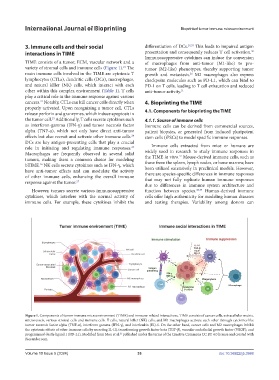
            TIME consists of a tumor, ECM, vascular network and a   of macrophages from anti-tumor (M1-like) to pro-
            variety of stromal cells and immune cells (Figure 1).  The   tumor (M2-like) phenotypes, thereby supporting tumor
                                                      21
            main immune cells involved in the TIME are cytotoxic T   growth and metastasis.  M2 macrophages also express
                                                                                  26
            lymphocytes (CTLs), dendritic cells (DCs), macrophages,   checkpoint molecules such as PD-L1, which can bind to
            and natural killer (NK) cells, which interact with each   PD-1 on T cells, leading to T cell exhaustion and reduced
            other within this complex environment (Table 1). T cells   anti-tumor activity. 31
            play a critical role in the immune response against various
            cancers.  Notably, CTLs can kill cancer cells directly when   4. Bioprinting the TIME
                  22
            properly activated. Upon recognizing a tumor cell, CTLs   4.1. Components for bioprinting the TIME
            release perforin and granzymes, which induce apoptosis in
            the tumor cell.  Additionally, T cells secrete cytokines such   4.1.1. Source of immune cells
                       23
            as interferon-gamma (IFN-γ) and tumor necrosis factor   Immune cells can be derived from commercial sources,
            alpha (TNF-α), which not only have direct anti-tumor   patient biopsies, or generated from induced pluripotent
            effects but also recruit and activate other immune cells.    stem cells (iPSCs) to model specific immune responses.
                                                         24
            DCs are key antigen-presenting cells that play a crucial
            role in initiating and regulating immune responses.    Immune cells extracted from mice or humans are
                                                         25
            Macrophages are frequently observed in several solid   widely used in research to study immune responses in
                                                                             37
            tumors, making them a common choice for modeling   the TIME in vitro.  Mouse-derived immune cells, such as
            bTIME.  NK cells secrete cytokines such as IFN-γ, which   those from the spleen, lymph nodes, or bone marrow, have
                  26
            have anti-tumor effects and can modulate the activity   been utilized extensively in preclinical models. However,
            of other immune cells, enhancing the overall immune   there are species-specific differences in immune responses
                                                               that may not fully replicate human immune responses
            response against the tumor.
                                  27
                                                               due to differences in immune system architecture and
               However, tumors secrete various immunosuppressive   function between species. 38,39  Human-derived immune
            cytokines, which interfere with the normal activity of   cells offer high authenticity for modeling human diseases
            immune cells. For example, these cytokines inhibit the   and  testing  therapies.  Variability  among  donors can


            Figure 1. Components of tumor immune microenvironment (TIME) and immune-related interactions. TIME consists of cancer cells, extracellular matrix,
            microvessels, various stromal cells and immune cells. T cells, natural killer (NK) cells, and M1 macrophages activate each other through cytokines like
            tumor necrosis factor alpha (TNF-α), interferon gamma (IFN-γ), and interleukin (IL)-6. On the other hand, cancer cells and M2 macrophages inhibit
            the cytotoxic effects of other immune cells by secreting IL-10, transforming growth factor beta (TGF-β), vascular endothelial growth factor (VEGF), and
            programmed death-ligand 1 (PD-L1). Modified from Mou et al.  published under the terms of the Creative Commons CC BY 4.0 license and created with
                                                    21
            Biorender.com.

            Volume 10 Issue 5 (2024)                        33                                doi: 10.36922/ijb.3988

