


Page 445 - IJB-10-5
P. 445
International Journal of Bioprinting                            Bioprinting for large-sized tissue delivery


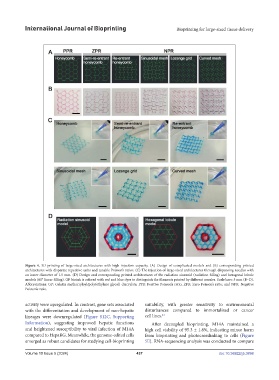
            Figure 4.  3D  printing  of  large-sized  architectures  with high injection  capacity.  (A) Design  of  complicated  models and  (B)  corresponding printed
            architectures with disparate repetitive units and tunable Poisson’s ratios. (C) The injection of large-sized architectures through dispensing needles with
            an inner diameter of 1.5 mm. (D) Design and corresponding printed architectures of the radiation sinusoid (radiation filling) and hexagonal lobule
            models (60° linear filling). GP bioink is colored with red and blue dyes to distinguish the filaments printed by different nozzles. Scale bars: 5 mm (B–D).
            Abbreviations: GP: Gelatin methacryloyl/poly(ethylene glycol) diacrylate; PPR: Positive Poisson’s ratio; ZPR: Zero Poisson’s ratio; and NPR: Negative
            Poisson’s ratio.


            activity were upregulated. In contrast, gene sets associated   suitability, with greater sensitivity to environmental
            with the differentiation and development of non-hepatic   disturbances compared to immortalized or cancer
            lineages were downregulated (Figure S12C, Supporting   cell lines. 41
            Information), suggesting improved hepatic functions   After decoupled bioprinting, M14A maintained a
            and heightened susceptibility to viral infection of M14A   high cell viability of 95.3 ± 1.8%, indicating minor harm
            compared to HepaRG. Meanwhile, the genome-edited cells   from bioprinting and photocrosslinking to cells (Figure
            emerged as robust candidates for studying cell-bioprinting   5E). RNA-sequencing analysis was conducted to compare

            Volume 10 Issue 5 (2024)                       437                                doi: 10.36922/ijb.3898

