


Page 52 - IJB-6-1
P. 52
HRP plus glucose-mediated bioprinting
           3.2 Cell behavior in the printed construct          cells by printing with the proposed cross-linking
                                                               method. Moreover, the printed construct stably
           To ensure the feasibility of applying the proposed   maintained  its  shape  and  dimension  even  after
           bioink and cross-linking method for printing living   7 days of culture in the presence of cells. The cell
           cells, the cell-laden lattice-shaped constructs were   viability in the construct (56.0 ± 2.4%, n = 3) at
           prepared. Mouse 10T1/2 fibroblasts were chosen as   day 7 was found to be higher than that in the non-
           a model cell line for the cell studies. As non-printed   printed hydrogel (44.3 ± 2.5%, n=3). The reason
           hydrogels for comparison,  the  hydrogels were      of this difference in cell viability may be due to the
           prepared in cell culture well plate using the same   different  internal  architecture  of  the  printed  and
           bioink. As shown in Figure 5, the homogeneous       non-printed  bulk  hydrogel.  It was reported  that
           distributions  of viable  cells were observed in    the internal geometrical features of cell enclosed
           both non-printed (50.1 ± 0.4% viability, n=3) and   hydrogel have influence on cell fate . However,
                                                                                                 [41]
           printed hydrogels (54.1 ± 0.6% viability,  n=3)     the decreases of cell density in both hydrogels
           after 1 day of culture. These similar cell viabilities   were observed. This is most likely  attributed  to
           indicate that there were no harmful effects on the   the dead cells that were not stained due to the cell

                        A
                            Day 0                  Day 4                   Day 8


                        B    1.3


                            0 (-)  1.2

                            Diameter / Diameterday  1.1


                               1


                             0.9


                             0.8
                                  0           2           4           6          8           10
                                                     Soaking time (day)

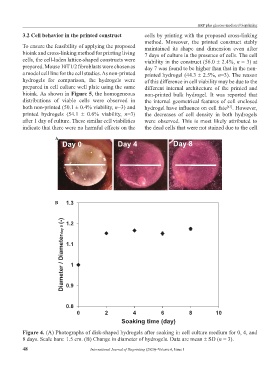
           Figure 4. (A) Photographs of disk-shaped hydrogels after soaking in cell culture medium for 0, 4, and
           8 days. Scale bars: 1.5 cm. (B) Change in diameter of hydrogels. Data are mean ± SD (n = 3).

           48                          International Journal of Bioprinting (2020)–Volume 6, Issue 1

