


Page 50 - IJB-6-1
P. 50
HRP plus glucose-mediated bioprinting
           D-glucose (44  mg/mL),  and CNF (1.5 w/v%)          using  a  fluorescence  microscope  (BZ-9000,
           at 5 × 10  cells/mL, as a bioink. The cell-laden    Keyence Corp., Osaka, Japan).
                    5
           lattice-shaped constructs were printed in a safety
           cabinet and kept in an incubator until the complete   2.6 Switching hydrogel surface
           cross-linking.  As a non-printed  hydrogel,  the    Lattice-shaped  hydrogel  construct  was printed
           mixture  solution was poured into 24-well plate     first using the selected ink on a culture dish with
           at  0.25  mL/well.  The  resultant  hydrogels  were   a surface covered with 1.0% agarose gel. After
           incubated  in DMEM at  37°C.  After 1  day and      post-cross-linking,  the  hydrogel  construct  was
           7  days of incubation,  the  cells  in  hydrogels   soaked in a solution containing Rho-Gel-Ph
           were  stained  with  Calcein-AM (live  cells)  and   (1.0 w/v%) for overnight at 37°C.  Then, the
           propidium iodide (dead cells) for the observation   construct  was rinsed well with PBS to remove


           A                                                 B


           C                                                 D


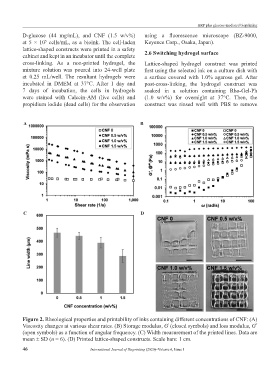
           Figure 2. Rheological properties and printability of inks containing different concentrations of CNF: (A)
           Viscosity changes at various shear rates. (B) Storage modulus, G (closed symbols) and loss modulus, G
                                                                         ʹ
                                                                                                              ʹʹ
           (open symbols) as a function of angular frequency. (C) Width measurement of the printed lines. Data are
           mean ± SD (n = 6). (D) Printed lattice-shaped constructs. Scale bars: 1 cm.
           46                          International Journal of Bioprinting (2020)–Volume 6, Issue 1

