


Page 73 - IJB-6-1
P. 73
Lee, et al.

                                                                                  BioSeg
                                                                                  File Processing
                                                  STL        G-code               Conventional
                                                                                  File Processing
                                    File          STL        G-code
                                 Segmentation     STL        G-code       Compilation
                                                        .
                                                        .
                                                        .
                          CAD Model                                                   Bioprinting


                                              STL           G-code        Compilation
           Figure 2. Process flow for file preparation for bioprinting, comparing between the two different file
           processing methods.

           rate of dissolution, providing sufficient time before   A                 B
           secondary cross-linking through ultraviolet (UV)
           cross-linking of GelMA.

           4.1 Freestanding coil

           The coil is designed with both materials interlacing
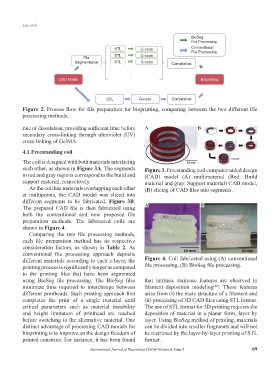
           each other, as shown in Figure 3A. The segments     Figure 3. Freestanding coil computer-aided design
           in red and gray regions correspond to the build and   (CAD) model (A) multimaterial  (Red: Build
           support material, respectively.                     material and gray: Support material) CAD model,
             As the coil has materials overlapping each other   (B) slicing of CAD files into segments.
           at multipoints, the CAD model  was sliced  into
           different  segments to be fabricated,  Figure  3B.
           The  prepared  CAD  file  is  then  fabricated  using   A                  B
           both  the  conventional  and  new  proposed  file
           preparation  methods.  The  fabricated  coils  are
           shown in Figure 4.
             Comparing  the  two  file  processing  methods,
           each  file  preparation  method  has  its  respective
           consideration  factors, as shown in  Table  2. As
           conventional  file  processing  approach  deposits
           different materials according to each z-layer, the   Figure 4. Coil fabricated using (A) conventional
           printing process is significantly longer as compared   file processing, (B) BioSeg file processing.
           to  the  printing  files  that  have  been  segmented
           using  BioSeg  file  processing.  The  BioSeg  files   that  intrinsic  staircase  features are observed in
           minimize  time  required  to  interchange  between   filament  deposition  modeling . These  features
                                                                                            [45]
           different printheads. Such printing approach first   arise from (i) the basic structure of a filament and
           completes the print of a single material  until     (ii) processing of 3D CAD files using STL format.
           critical  parameters  such as material  instability   The use of STL format for 3D printing requires the
           and height  limitation  of printhead  are  reached   deposition of material in a planar form, layer by
           before switching to the alternative material. One   layer. Using BioSeg method of printing, materials
           distinct advantage of processing CAD models for     can be divided into smaller fragments and will not
           bioprinting is to improve on the design freedom of   be restricted by the layer-by-layer printing of STL
           printed construct. For instance, it has been found   format.

                                       International Journal of Bioprinting (2020)–Volume 6, Issue 1        69

