


Page 106 - IJB-6-4
P. 106
Triple-layered coaxial nozzle for 3D bioprinting
           experiments were conducted with three different     and the three of them fell within the material’s
           nozzles. As shown in Table 1, nozzles 1 and 2 allow   printing window, as they allowed controlled and
           the  fabrication  of  single-layered  hollow  tubular   continuous deposition of a filament. An alginate-
           structures of equal outer diameter (OD), but with   based bioink embedded  with MG-63 cells  was
           different  layer  thicknesses.  Likewise,  nozzle  3   chosen for this evaluation since alginate is a widely
           allows the fabrication of structures with a greater   used biocompatible  material,  easily  extrudable
           diameter and layer thickness than nozzles 1 and 2.   and features  rapid  crosslinking upon exposition
           These nozzles were subsequently 3D printed with     to divalent cations, which enables excellent shape
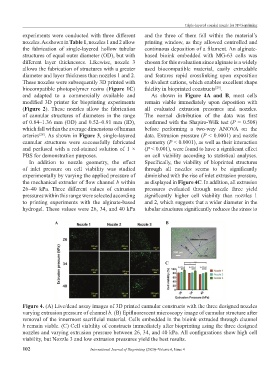
           biocompatible photopolymer  resins  (Figure  1C)    fidelity in bioprinted constructs .
                                                                                             [29]
           and adapted  to a commercially  available  and        As shown in  Figure  4A and B, most cells
           modified  3D  printer  for  bioprinting  experiments   remain viable immediately upon deposition with
           (Figure  2).  These  nozzles  allow  the  fabrication   all evaluated extrusion pressures and nozzles.
           of cannular structures of diameters  in the range   The  normal  distribution  of  the  data  was  first
           of 0.84–1.36 mm (OD) and 0.52–0.91 mm (ID),         confirmed with the Shapiro-Wilk test (P = 0.508)
           which fall within the average dimensions of human   before performing a two-way  ANOVA on the
           arteries . As shown in Figure 3, single-layered     data. Extrusion pressure (P < 0.0001) and nozzle
                  [28]
           cannular structures were successfully fabricated    geometry (P < 0.0001), as well as their interaction
           and perfused with a red-stained  solution of 1 ×    (P < 0.001), were found to have a significant effect
           PBS for demonstration purposes.                     on cell viability according to statistical analyses.
             In  addition  to  nozzle  geometry,  the  effect   Specifically,  the  viability  of  bioprinted  structures
           of  inlet  pressure on cell  viability  was studied   through  all  nozzles  seems  to  be  significantly
           experimentally by varying the applied pressure of   diminished with the rise of inlet extrusion pressure,
           the mechanical extruder of flow channel b within    as displayed in Figure 4C. In addition, all extrusion
           26–40  kPa.  Three  different  values  of  extrusion   pressures evaluated through nozzle three yield
           pressures within this range were selected according   significantly  higher  cell  viability  than  nozzles  1
           to printing experiments  with the alginate-based    and 2, which suggests that a wider diameter in the
           hydrogel. These values were 26, 34, and 40 kPa      tubular structures significantly reduces the stress to


                        A                                              B


                                                                       C


           Figure 4. (A) Live/dead assay images of 3D printed cannular constructs with the three designed nozzles
           varying extrusion pressure of channel b. (B) Epifluorescent microscopy image of cannular structure after
           removal of the innermost sacrificial material. Cells embedded in the bioink extruded through channel
           b remain viable. (C) Cell viability of constructs immediately after bioprinting using the three designed
           nozzles and varying extrusion pressure between 26, 34, and 40 kPa. All configurations show high cell
           viability, but Nozzle 3 and low extrusion pressures yield the best results.

           102                         International Journal of Bioprinting (2020)–Volume 6, Issue 4

