


Page 46 - IJB-6-4
P. 46
Design and AM of a medical face shield
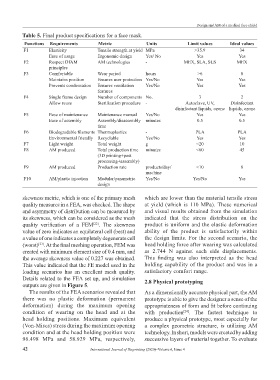
           Table 5. Final product specifications for a face mask.

           Functions  Requirements         Metric              Units             Limit values      Ideal values
           F1         Elasticity           Tensile strength at yield MPa            >35.9              34
                      Ease of usage        Ergonomic design    Yes/ No               Yes               Yes
           F2         Respect DfAM         AM technologies     -               MEX, SLA, SLS          MEX
                      principles
           F3         Comfortable          Wear period         hours                 >6                8
                      Maintains position   Ensures user protection Yes/No            Yes               Yes
                      Prevents condensation  Ensures ventilation   Yes/No            Yes               Yes
                                           features
           F4         Single frame design  Number of components No.                   3                2
                      Allow reuse          Sterilization procedure  -           Autoclave, UV,     Disinfectant
                                                                            disinfectant liquids, ozone liquids, ozone
           F5         Ease of maintenance  Maintenance manual  Yes/No                Yes               Yes
                      Ease of assembly     Assembly/disassembly  minutes             0.5               0.5
                                           time
           F6         Biodegradable filaments Thermoplastics   -                    PLA               PLA
                      Environmental friendly Recyclable        Yes/No                Yes               Yes
           F7         Light weight         Total weight        g                     <20               10
           F8         AM produced          Total production time   minutes           <60               45
                                           (3D printing+post
                                           processing+assembly)
           F9         AM produced          Production rate     products/day/         <10               8
                                                               machine
           F10        AM/plastic injection  Modular/parametric   Yes/No            Yes/No              Yes
                                           design


           skewness metric, which is one of the primary mesh   which are lower than the material tensile stress
           quality measures in a FEA, was checked. The shape   at yield (which is 110 MPa). These numerical
           and asymmetry of distribution can be measured by    and visual results obtained from the simulation
           its skewness, which can be considered as the mesh   indicated  that  the  stress  distribution  on  the
           quality  verification  of  a  FEM .  The  skewness   product is uniform and the elastic deformation
                                         [22]
           value of zero indicates an equilateral cell (best) and   ability  of  the  product  is  satisfactorily  within
           a value of one indicates a completely degenerate cell   the design limits. For the second scenario, the
           (worst) . At the final meshing operation, FEM was   head holding force after wearing was calculated
                 [23]
           created with minimum element size of 0.4 mm, and    as  2.744  N  against  each  side  displacements.
           the average skewness value of 0.227 was obtained.   This  finding  was  also  interpreted  as  the  head
           This value indicated that the FE model used in the   holding capability of the product and was in a
           loading  scenarios  has  an  excellent  mesh  quality.   satisfactory comfort range.
           Details related to the FEA set up, and simulation   2.8 Physical prototyping
           outputs are given in Figure 5.
             The results of the FEA scenarios revealed that    As a dimensionally accurate physical part, the AM
           there  was  no  plastic  deformation  (permanent    prototype is able to give the designer a sense of the
           deformation)  during  the  maximum  opening         appropriateness of form and fit before continuing
           condition  of  wearing  on  the  head  and  at  the   with  production .  The  fastest  technique  to
                                                                               [24]
           head  holding  positions.  Maximum  equivalent      produce a physical prototype, most especially for
           (Von-Mises) stress during the maximum opening       a  complex  geometric  structure,  is  utilizing  AM
           condition and at the head holding position were     technology. In short, models were created by adding
           96.498  MPa  and  58.929  MPa,  respectively,       successive layers of material together. To evaluate

           42                          International Journal of Bioprinting (2020)–Volume 6, Issue 4

