


Page 391 - IJB-10-6
P. 391
International Journal of Bioprinting                        Innovative manufacturing of ω-3-enriched chocolate


            131.33 and 242.93 J/g; the ΔH values of dark chocolate   This finding was due to the lower amount of ω-3 in the
            samples increased with the addition of ω-3 and ω-3-SA   coated chocolate compared to the mix and the coating of
            (Table 3). The T  of pure chocolate used in this study was   the ω-3 with SA. The decrease in T  is likely caused by the
                                                                                           m
                         m
            35.80°C. The T  values for chocolate mixed with ω-3 and   changes in the thermal properties of the ω-3 oil. In studies
                        m
            chocolate coated with ω-3 were measured as 32.41 and   where particles were added to chocolate, no significant
            33.46°C, respectively. Similar results were noted for the   change in the  T  of chocolate was noted. 48,58  Similarly,
                                                                            m
            T  of pure chocolate, as noted in the literature.  Another   adding ω-3 into chocolate did not significantly change its
                                                  56
             m
            study  reported  that  crystalline chocolate  exhibits  a    thermal properties.
            T  range of 33.8–35°C ; this value is similar to our finding,
                             57
             m
            i.e., approximately 35.8°C. The increased melting behavior   3.8. Total phenolic content and antioxidant capacity
                                                               of chocolate samples
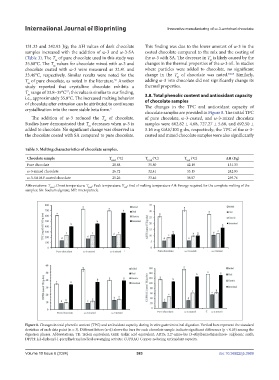
            of chocolate after extrusion can be attributed to continuous   The changes in the TPC and antioxidant capacity of
            crystallization into the more stable beta form. 6
                                                               chocolate samples are provided in Figure 8. The initial TPC
               The addition of ω-3 reduced the  T  of chocolate.   of pure chocolate, ω-3-coated, and ω-3-mixed chocolate
                                             m
            Studies have demonstrated that T  decreases when ω-3 is   samples were 602.82 ± 4.68, 727.27 ± 5.68, and 692.50 ±
                                       m
            added to chocolate. No significant change was observed in   3.16 mg GAE/100 g dw, respectively; the TPC of the ω-3-
            the chocolate coated with SA compared to pure chocolate.   coated and mixed chocolate samples were also significantly
            Table 3. Melting characteristics of chocolate samples.
             Chocolate sample                   T onset  (°C)  T peak  (°C)     T  (°C)          ΔH (J/g)
                                                                                 end
             Pure chocolate                      28.88          35.80            42.19            131.33
             ω-3-mixed chocolate                 26.72          32.41            35.15            242.93
             ω-3-SA MP-coated chocolate          25.26          33.46            36.07            239.76

            Abbreviations: T onset : Onset temperature; T peak : Peak temperature; T : End of melting temperature ΔH: Energy required for the complete melting of the
                                                      end
            samples; SA: Sodium alginate; MP: microparticle.


            Figure 8. Changes in total phenolic content (TPC) and antioxidant capacity during in vitro gastrointestinal digestion. Vertical bars represent the standard
            deviation of each data point (n = 3). Different letters (a–d) above the bars for each chocolate sample indicate significant differences (p < 0.05) among the
            digestion phases. Abbreviations: TE: Trolox equivalent; GAE: Gallic acid equivalent; ABTS: 2,2ʹ-azino-bis (3-ethylbenzothiazoline6- sulphonic acid);
            DPPH: 2,2-diphenyl-1-picrylhydrazyl radical scavenging activity; CUPRAC: Copper-reducing antioxidant capacity.


            Volume 10 Issue 6 (2024)                       383                                doi: 10.36922/ijb.3969

