


Page 55 - IJB-10-6
P. 55
International Journal of Bioprinting                               Semi-solid extrusion for pediatric medicine


                                                                                                 Continued
                Ref.  102        103    104      105    106  107     108      109      110


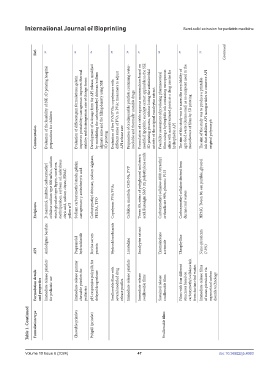
                Commentaries Evaluation of the feasibility of SSE 3D printing hospital   preparations for children  Evaluation of different gum formulations; gelatin  improves printability; carrageenan improves thermal  stability and disintegration rate of dosage forms Development of a dosage form for API release, modified  by modulating the carboxymethyl chitosan/sodium  alginate ratio and the filling density using SSE    3D printing Evaluation of five PVA/PVAc copolymer


                     D-mannitol, maltitol, carboxymethyl  cellulose sodium type 800 mPa/s, sodium  starch glycolate type lippin, sucralose,  methylparaben, soybean oil, anhydrous  citric acid, sodium citrate, FD&C    Sodium carboxymethyl starch; gelatin;  carrageenan; γ-aminobutyric acid  Carboxymethyl chitosan, sodium alginate,   Cellulose; manitole; CMS-Na; PVP  Tween 80, esters of polyglycerol and stearic  acid, Eumulgin SMO 20, polyethylene oxide  Carboxymethyl cellul


                Excipients     yellow n°5  PEGDA, TPO  Copolymer PVA/PVAc        durian rind wastes


                     Amlodipine besylate  hydrochloride  Bovine serum   Hydrochlorothiazide  Eucalyptus extract  Triamcinolone   Theophylline  Nano-piroxicam


                API               Propranolol   protein  Loratadine     acetonide        (7.5%)


                Formulation details    and properties  Immediate-release printlets   for pediatric use  Immediate-release gummy   chewable printlets for   pediatrics  pH-responsive polypills for   delayed drug release  Swallowable films with   several modified drug   release profiles  Immediate-release printlets  Immediate-release   swallowable films  Sustained release   swallowable films  Films with four different   structures based on  carboxymethyl cellulose ink   from


             Table 1. Continued  Formulation type  Chewable printlets  Polypill (printlet)  Swallowable films


            Volume 10 Issue 6 (2024)                        47                                doi: 10.36922/ijb.4063

