


Page 559 - IJB-10-6
P. 559
International Journal of Bioprinting                               Internally-crosslinked ADA/Alg/Gel bioinks


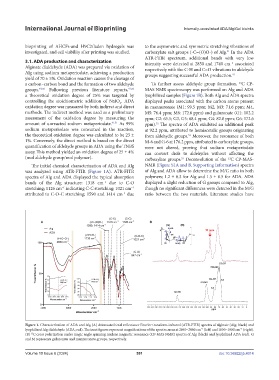
            bioprinting  of  AHCFs-and  H9C2/laden  hydrogels  was   to the asymmetric and symmetric stretching vibrations of
            investigated, and cell viability after printing was studied.  carboxylate salt groups (-C=(O)O-) of Alg.  In the ADA
                                                                                                  41
                                                               ATR-FTIR spectrum, additional bands with very low
            3.1. ADA production and characterization           intensity were detected at 2850 and 1740 cm  associated
                                                                                                   −1
            Alginate dialdehyde (ADA) was prepared via oxidation of   respectively with the C-H and C=O vibrations in aldehyde
            Alg using sodium metaperiodate, achieving a production   groups suggesting successful ADA production. 41
            yield of 70 ± 5%. Oxidation reaction causes the cleavage of
            a carbon–carbon bond and the formation of two aldehyde   To further assess aldehyde group formation,  C CP-
                                                                                                       13
            groups. 49,50  Following previous literature reports, 41,50    MAS NMR spectroscopy was performed on Alg and ADA
            a theoretical oxidation degree of 25% was targeted by   lyophilized samples (Figure 1B). Both Alg and ADA spectra
            controlling the  stoichiometric  addition  of NaIO . ADA   displayed peaks associated with the carbon atoms present
                                                    4
            oxidation degree was measured by both indirect and direct   in mannuronate (M1: 99.5 ppm; M2, M3: 71.6 ppm; M4,
            methods. The indirect method was used as a preliminary   M5: 76.4 ppm; M6: 172.6 ppm) and guluronate (G1: 102.2
            assessment of the oxidation degree by measuring the   ppm; G2: 65.5; G3, G5: 68.4 ppm; G4: 82.8 ppm; G6: 172.6
            amount of unreacted sodium metaperiodate. 41,51  As 99%   ppm).  The spectra of ADA exhibited an additional peak
                                                                    52
            sodium metaperiodate was consumed in the reaction,   at 92.2 ppm, attributed to hemiacetalic groups originating
            the theoretical oxidation degree was calculated to be 23 ±   from aldehydic groups.  Moreover, the resonance of both
                                                                                 53
            1%. Conversely, the direct method is based on the direct   M-6 and G-6 at 176.2 ppm, attributed to carboxylate groups,
            quantification of aldehyde groups in ADA using the TNBS   were  not  altered,  proving that  sodium  metaperiodate
            assay. This method yielded an oxidation degree of 25 ± 4%   can convert diols to aldehydes without affecting the
            (mol aldehyde group/mol polymer).                  carboxylate  groups.  Deconvolution of the  C CP-MAS-
                                                                              53
                                                                                                  13
               The initial chemical characterization of ADA and Alg   NMR (Figure S1A and B, Supporting Information) spectra
            was analyzed using ATR-FTIR (Figure 1A). ATR-FITR   of Alg and ADA allow to determine the M/G ratio in both
            spectra of Alg and ADA displayed the typical absorption   polymers; 1.2 ± 0.3 for Alg and 1.5 ± 0.5 for ADA. ADA
                                             −1
            bands of the Alg structure: 1318 cm  due to C-O    displayed a slight reduction of G groups compared to Alg,
            stretching; 1126 cm  indicating C-C stretching; 1021 cm    though no significant differences were detected in the M/G
                           −1
                                                         −1
            attributed to C-O-C stretching; 1590 and 1414 cm  due   ratio between the two materials. Literature studies have
                                                     −1


            Figure 1. Characterization of ADA and Alg (A) Attenuated total reflectance Fourier transform infrared (ATR-FTIR) spectra of alginate (Alg; black) and
            lyophilized Alg dialdehyde (ADA; red). The inset figures represent magnifications of the spectra areas at 2840–2860 cm  (left) and 1650–1800 cm  (right).
                                                                                       −1
                                                                                                       −1
            (B)  C cross polarization under magic angle spinning nuclear magnetic resonance (CP-MAS NMR) spectra of Alg (black) and lyophilized ADA (red). G
              13
            and M represents guluronate and mannuronate groups, respectively.
            Volume 10 Issue 6 (2024)                       551                                doi: 10.36922/ijb.4014

