


Page 62 - IJB-7-1
P. 62
Additive Manufacture of Emulsion Inks to Produce Respiratory Protective Filters
                        A                                    B


                        C                                    D


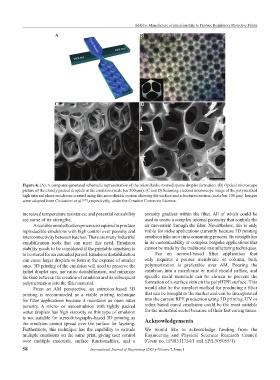
           Figure 4. (A). A computer-generated schematic representation of the microfluidic monodisperse droplet formation. (B) Optical microscope
           picture of the closely packed droplets in the emulsion (scale bar 200 µm). (C and D) Scanning electron microscope image of the polymerized
           high internal phase emulsions created using this microfluidic system showing the surface and a fractured section (scale bar 100 µm). Images
           were adapted from Costantini et al. [125]   ,respectively, under the Creative Commons License.


           increased temperature resistance, and potential reusability   porosity  gradient  within  the  filter. All  of  which  could  be
           are some of its strengths.                          used to create a complex internal geometry that controls the
               A scalable emulsification process is required to produce   air movement through the filter. Nevertheless, this is only
           reproducible emulsions with high control over porosity and   viable for niche applications currently because 3D printing
           interconnectivity between batches. There are many industrial   emulsion inks are a time-consuming process. Its strength lies
           emulsification  tools  that  can  meet  this  need.  Emulsion   in its customizability or complex bespoke applications that
           stability needs to be considered if the printable emulsion is   cannot be made by the traditional manufacturing techniques.
           to be stored for an extended period. Emulsion destabilization   For  an  aerosol-based  filter  application  that
           can cause larger droplets to form at the expense of smaller   only  requires  a  porous  membrane  or  column,  bulk
           ones. 3D printing of the emulsion will need to preserve the   polymerization  is preferable  over  AM.  Pouring the
           initial droplet size, not cause destabilization, and minimize   emulsion into a membrane or mold should suffice, and
           the time between the creation of emulsion and its subsequent   specific  mold  materials  can  be  chosen  to  prevent  the
           polymerization into the filter material.            formation of a surface skin on the polyHIPE surface. This
               From  an  AM  perspective,  an  extrusion-based  3D   would also be the simplest method for producing a filter
           printing  is  recommended  as  a  viable  printing  technique   that can be brought to the market and can be incorporated
           for  filter  applications  because  it  maintains  an  open  outer   into the current RPE production using 3D printing. UV or
           porosity.  A  micro-  or nanoemulsion  with tightly  packed   redox based cured emulsions could be the most suitable
           water droplets has high viscosity so this type of emulsion   for the industrial sector because of their fast curing times.
           is not suitable for stereolithography-based 3D printing as   Acknowledgements
           the emulsion cannot spread over the surface for layering.
           Furthermore,  this  technique  has  the  capability  to  extrude   We  would  like  to  acknowledge  funding  from  the
           multiple emulsions on the same print, giving user control   Engineering  and Physical Sciences Research Council
           over multiple materials, surface functionalities, and a   (Grant no. EP/R511754/1 and EP/L505055/1).
           58                          International Journal of Bioprinting (2021)–Volume 7, Issue 1

