


Page 21 - IJB-7-2
P. 21
Zhang, et al.
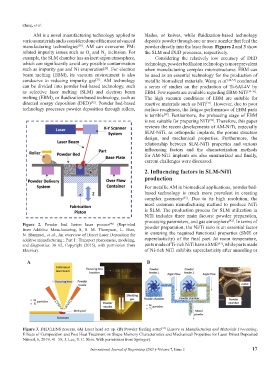
               AM is a novel manufacturing technology applied to   blades,  or  knives,  while  fluidization-based  technology
           various materials and is considered one of the most advanced   deposits powder through one or more nozzles that feed the
           manufacturing technologies . AM can overcome PM-    powder directly into the laser focus. Figures 2 and 3 show
                                  [30]
           related impurity issues such as O  and N  inclusion. For   the SLM and DED processes, respectively.
                                              2
                                       2
           example, the SLM chamber has an inert argon atmosphere,   Considering the relatively low accuracy of DED
           which can significantly avoid any possible contamination   technology, powder bed fusion technology is more prevalent
           such as impurity gas and Ni evaporation . For electron   when manufacturing complex microstructures. EBM can
                                             [29]
           beam melting (EBM), its vacuum environment is also   be used as an essential technology for the production of
           conducive to reducing impurity gas . AM  technology   metallic biomedical materials. Wang et al. [22,33]  conducted
                                          [31]
           can be divided into powder bed-based technology, such   a series of studies on the production of  Ti-6Al-4V by
           as selective laser melting (SLM) and electron beam   EBM. Few reports are available regarding EBM-NiTi [34-36] .
           melting (EBM), or fluidization-based technology, such as   The high vacuum conditions of EBM are suitable for
           directed energy deposition (DED) . Powder bed-based   reactive materials such as NiTi . However, due to poor
                                        [32]
                                                                                         [37]
           technology processes powder deposition through rollers,   surface roughness, the fatigue performance of EBM parts
                                                               is terrible . Furthermore, the preheating stage of EBM
                                                                       [38]
                                                               is not suitable for preparing NiTi . Therefore, this paper
                                                                                          [39]
                                                               reviews the recent developments of AM-NiTi, especially
                                                               SLM-NiTi, as orthopedic implants, the porous structure
                                                               design, and mechanical properties. Furthermore, the
                                                               relationship between SLM-NiTi properties and various
                                                               influencing  factors  and  the  characterization  methods
                                                               for AM-NiTi implants are also summarized and finally,
                                                               current challenges were discussed.
                                                               2. Influencing factors in SLM-NiTi
                                                               production

                                                               For metallic AM in biomedical applications, powder bed-
                                                               based technology is much more prevalent  in creating
                                                               complex  geometry .  Due  to  its  high  resolution,  the
                                                                               [25]
                                                               most common  manufacturing  method  to produce  NiTi
                                                               is SLM. The production process for SLM utilization in
                                                               NiTi  includes  three  main  factors:  powder  preparation,
                                                               processing parameters, and gas atmosphere . In terms of
                                                                                                  [42]
           Figure  2.  Powder bed  fusion  laser  process   (Reprinted
                                                [40]
           from  Additive  Manufacturing,  8, S. M.  Thompson, L. Bian,   powder preparation, the Ni/Ti ratio is an essential factor
           N. Shamsaei, et al., An overview of Direct Laser Deposition for   in ensuring the required functional properties (SME or
           additive manufacturing ; Part I : Transport phenomena, modeling,   superelasticity)  of  the  final  part. At  room  temperature,
                                                                                              [43]
           and diagnostics, 36–62, Copyright (2015), with permission from   parts made of Ti-rich NiTi have a SME , while parts made
           Elsevier).                                          of Ni-rich NiTi exhibits superelasticity after annealing or
             A                                                  B


           Figure 3. DED/LENS process. (A) Laser head set up. (B) Powder feeding setup  (Lasers in Manufacturing and Materials Processing,
                                                                      [41]
           Effects of Composition and Post Heat Treatment on Shape Memory Characteristics and Mechanical Properties for Laser Direct Deposited
           Nitinol, 6, 2019, 41–58, J. Lee, Y. C. Shin. With permission from Springer).
                                       International Journal of Bioprinting (2021)–Volume 7, Issue 2        17

