


Page 33 - IJB-8-1
P. 33
Tian, et al.
               Trajectories from the lateral view (i.e., the yz-plane   that  of  the  human  finger  by  a  large  margin.  On  the
           in Figure 2) of the 6 designs are reported in Figure 10.   contrary, all our five designs are more flexible and can
           We observed that the flexion of the baseline (Design 5)   better replicate the human finger. We notice that designs
           was limited as its minimum y coordinate was larger than   2  and  6 had  the  similar  deformation  curves;  therefore,

           Table 3. Comparison of the joint connectors in various robotic hand designs
           Connector                Type      Maximum restoring force  Force transmission
           Fishing line             Ligament 0                         1 Bowden cable for flexion and extension
           Crocheted ligament       Ligament 0                         1 cable for flexion and 1 cable for extension
           Solid pin                Hinge     0                        1 cable for flexion and 1 cable for extension
           Flexible pin             Hinge     0                        1 cable for flexion and 1 cable for extension
           Rubber band (this design)  Ligament 1.5 N with 2 mm rubber band 1  cable  for  flexion,  extension  achieved  via  the
                                                                       restoring force
           Rubber band (this design)  Ligament 3.1 N with 4 mm rubber band 1  cable  for  flexion,  extension  achieved  via  the
                                                                       restoring force

          Table 4. Ablation study on the finger design
           Design   Cable link method  Joint connector  Pulley solution              Maximum force   DIP ROM
           1       Through hole and knot 4 mm rubber band 2 holes through phalanx       18.973N       [0 , 95 ]
                                                                                                       o
                                                                                                           o
                                                       (2 mm beneath  the  surface  of
                                                       phalanx)
           2       Through hole and knot 4 mm rubber band 2 holes through phalanx        8.652N       [0 , 90 ]
                                                                                                       o
                                                                                                           o
                                                       (3 mm beneath  the  surface  of
                                                       phalanx)
           3       DIP attaching knot  2 mm rubber band 2 holes through phalanx         10.301N       [0 , 90 ]
                                                                                                       o
                                                                                                           o
                                                       (1 mm beneath  the  surface  of
                                                       phalanx)
           4       DIP attaching knot  2 mm rubber band 1 hole through phalanx          23.348N      [0 , 100 ]
                                                                                                       o
                                                                                                            o
                                                       (1 mm beneath  the  surface  of
                                                       phalanx) 2 nylon string windings
           5       Inside knot         Pin joint       Hollow body                       3.345N       [0 , 70 ]
                                                                                                       o
                                                                                                           o
           6       Through hole and knot 4 mm rubber band 4 nylon string windings       19.306N      [0 , 100 ]
                                                                                                            o
                                                                                                       o
          Maximum forces are measured from fingertip (in N), and ranges of motion are measured by the rotation angle of DIP (in degree).


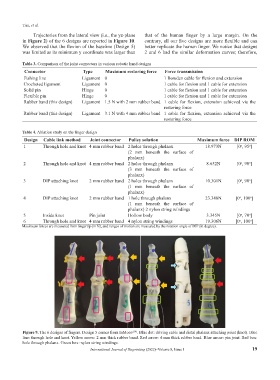
           Figure 9. The 6 designs of fingers. Design 5 comes from InMoov . Blue dot: driving cable and distal phalanx attaching point (knot). Blue
                                                          [39]
           line: through hole and knot. Yellow arrow: 2 mm thick rubber band. Red arrow: 4 mm thick rubber band. Blue arrow: pin joint. Red box:
           hole through phalanx. Green box: nylon string windings.
                                       International Journal of Bioprinting (2022)–Volume 8, Issue 1        19

