


Page 58 - IJB-8-2
P. 58
CFD Assessment of Extrusion Bioprinting Parameters
           rate for the cylindrical nozzle was 0.00014 kg/s at an   3.3. Dispensing pressure
           inlet pressure of 0.05 MPa. Consequently, at equivalent   Cells are exposed to various mechanical  forces while
           flow rates, cell damage was lower in a tapered needle   moving  through  the  nozzles;  this  generates  internal
           compared to a cylindrical one [27] .                pressures that can damage the cells . These forces are
                                                                                             [7]
           3.2. Nozzle diameter                                directly  proportional to the dispensing pressure as it
                                                               determines  the force with which the extruded  material
           As shown in  Figure  5, for both tapered conical and   is being pushed. Increasing the dispensing pressure
           conical  nozzles,  our  findings  agree  that  as  the  nozzle   also  increases  the  MWSS, much  like  decreasing  the
           diameter increases from 0.1 mm to 0.5 mm, the MWSS   nozzle diameter. Nair et al.  suggested that the effect
                                                                                      [31]
           decreases under constant pressure, possibly leading to   of increasing  the  inlet  pressure  has a  more  prominent
           greater cell viability. As shown in Table 3, the decrease   negative  effect  on  cell  viability  than  nozzle  diameter.
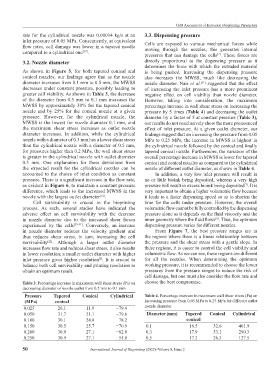
           of the diameter from 0.5 mm to 0.1 mm increases the   However, taking into consideration,  the maximum
           MWSS by approximately 30% for the tapered conical   percentage increase in wall shear stress on increasing the
           nozzle and by 25% for the conical nozzle at a given   pressure by 5 times (Table 4) and decreasing the outlet
           pressure. However, for the cylindrical nozzle, the   diameter by a factor of 5 at constant pressure (Table 3),
           MWSS is the lowest for nozzle diameter 0.1 mm, and   our results do not conclusively show the more pronounced
           the maximum shear stress increases as outlet nozzle   effect of inlet pressure. At a given outlet diameter, our
           diameter increases. In addition, while the cylindrical   findings suggest that on increasing the pressure from 0.05
           nozzle with a diameter of 0.3 mm has a lower shear stress   MPa to 0.25 MPa, the increase in MWSS is highest in
           than the cylindrical nozzle with a diameter of 0.5 mm,   the cylindrical nozzle followed by the conical and finally
           for pressures higher than 0.2 MPa, the wall shear stress   tapered conical nozzle. Furthermore, the variation of the
           is greater in the cylindrical nozzle with outlet diameter   overall percentage increase in MWSS is lower for tapered
           0.3  mm.  One  explanation  for  these  deviations  from   conical and conical nozzles as compared to the cylindrical
           the  expected  result  for  the  cylindrical  nozzles  can  be   nozzle of different outlet diameter, as shown in Table 4.
           accounted to the choice of inlet condition as constant   In addition, a very low inlet pressure will result in
           pressure. There is a significant increase in the flow rate,   no or little bioink being deposited, whereas a very high
           as evident in Figure 6, to maintain a constant pressure   pressure will result in excess bioink being deposited . It is
                                                                                                         [7]
           difference, which leads to the increased MWSS in the   very important to obtain a higher volumetric flow because
           nozzle with the largest outlet diameter [12] .      it leads to a faster dispensing speed so as to shorten the
               Cell  survivability  is crucial  in  the  bioprinting   time for the cells under pressure. However, the overall
           process.  As  such, several studies have indicated  the   volumetric flow cannot be fully controlled by the dispensing
           adverse  effect  on  cell  survivability  with  the  decrease   pressure alone as it depends on the fluid viscosity and the
           in nozzle diameter due to the increased shear forces   inner geometry where the fluid flows . Thus, the optimum
                                                                                             [8]
           experienced  by the cells [29-31] . Conversely, an increase   dispensing pressure varies for different nozzles.
           in nozzle diameter reduces the velocity  gradient  and   From  Figure  7,  the  best  pressure  ranges  are  in
           thus reduces shear stress, in turn, increasing  the cell   the regions where there is a linear relationship between
           survivability .  Although  a  larger  outlet  diameter   the pressure and the shear stress with a gentle slope. In
                     [22]
           increases flow rate and reduces shear stress, it also results   these regions, it is easier to control the cell viability and
           in lower resolution; a smaller outlet diameter with higher   volumetric flow. As we can see, these regions are different
           inlet  pressure gives  higher  resolution .  It  is  crucial  to   for all  the  nozzles.  When  determining  the  optimum
                                           [2]
           balance both cell survivability and printing resolution to   working pressure, it is recommended to choose the lower
           obtain an optimum result.                           pressures from the pressure ranges to reduce the risk of
                                                               cell damage, but one must also consider the flow rate and
           Table 3. Percentage increase in maximum wall shear stress (Pa) on   choose the best compromise.
           decreasing diameter of nozzle outlet from 0.5 mm to 0.1 mm
           Pressure     Tapered     Conical     Cylindrical    Table 4. Percentage increase in maximum wall shear stress (Pa) on
           (MPa)        conical                                increasing pressure from 0.05 MPa to 0.25 MPa for different outlet
           0.025          26.1        11.9        −79.4        nozzle diameter
           0.050          31.7        21.1        −79.6        Diameter (mm)    Tapered   Conical   Cylindrical
           0.100          30.1        24.0        −78.2                         conical
           0.150          30.5        25.7        −70.9        0.1                16.5      32.6       401.9
           0.200          30.9        27.1        −62.8        0.3                17.9      33.1       290.3
           0.250          30.9        27.1        −55.0        0.5                17.2      26.3       127.5

           50                          International Journal of Bioprinting (2022)–Volume 8, Issue 2

