


Page 60 - IJB-8-2
P. 60
CFD Assessment of Extrusion Bioprinting Parameters
                        A                                    B


                                         C


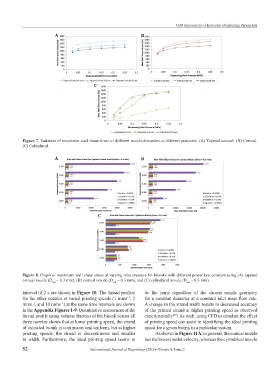
           Figure 7. Variation of maximum wall shear stress of different nozzle diameters at different pressures. (A) Tapered conical. (B) Conical.
           (C) Cylindrical.

                        A                                    B


                                           C


           Figure 8. Graph of maximum wall shear stress at varying inlet pressure for bioinks with different power-law constant using (A) tapered
           conical nozzle (D  = 0.3 mm), (B) conical nozzle (D  = 0.3 mm), and (C) cylindrical nozzle (D  = 0.3 mm).
                       out                       out                            out
           interval of 2 s are shown in Figure 10. The thread profiles   be  the same regardless of the chosen  nozzle geometry
           for the other nozzles at varied printing speeds (1 mms , 5   for a constant diameter at a constant inlet mass flow rate.
                                                       −1
           mms , and 10 mms ) at the same time intervals are shown   A change in the strand width results in decreased accuracy
               −1
                           −1
           in the Appendix Figures 1-9. Quantitative assessment of the   of the printed strand at higher printing speed as observed
           thread profile using volume fraction of the bioink across all   experimentally . As such, using CFD to simulate the effect
                                                                           [22]
           three nozzles shows that at lower printing speed, the strand   of printing speed can assist in identifying the ideal printing
           of extruded bioink is continuous and uniform, but at higher   speed for a given bioink in a particular system.
           printing speeds, the strand is discontinuous and smaller   As shown in Figure 11A, in general, the conical nozzle
           in width. Furthermore, the ideal printing speed seems to   has the lowest outlet velocity, whereas the cylindrical nozzle

           52                          International Journal of Bioprinting (2022)–Volume 8, Issue 2

