


Page 225 - IJB-9-1
P. 225
International Journal of Bioprinting                         Cellulose-based bio-inks for bone and cartilage TE


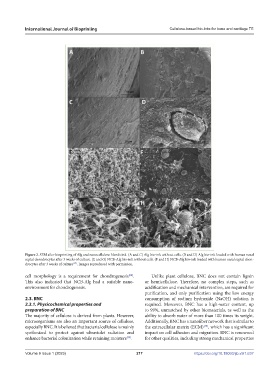
            Figure 2. SEM after bioprinting of Alg and nanocellulose blends ink. (A and C) Alg bio-ink without cells. (B and D) Alg bio-ink loaded with human nasal
            septal chondrocytes after 3 weeks of culture. (E and G) NCB-Alg bio-ink without cells. (F and H) NCB-Alg bio-ink loaded with human nasal septal chon-
                                [37]
            drocytes after 3 weeks of culture . Images reproduced with permission.
            cell morphology is a requirement for chondrogenesis .   Unlike plant cellulose, BNC does not contain lignin
                                                        [38]
            This also indicated that NCB-Alg had a suitable nano-  or hemicellulose. Therefore, no complex steps, such as
            environment for chondrogenesis.                    acidification and mechanical intervention, are required for
                                                               purification, and only purification using the low energy
            2.3. BNC                                           consumption of sodium hydroxide (NaOH) solution is
            2.3.1. Physicochemical properties and              required.  Moreover,  BNC  has  a  high-water  content,  up
            preparation of BNC                                 to 99%, unmatched by other biomaterials, as well as the
            The majority of cellulose is derived from plants. However,   ability to absorb water of more than 100 times its weight.
            microorganisms are also an important source of cellulose,   Additionally, BNC has a nanofiber network that is similar to
            especially BNC. It is believed that bacterial cellulose is mainly   the extracellular matrix (ECM) , which has a significant
                                                                                        [40]
            synthesized to protect against ultraviolet radiation and   impact on cell adhesion and migration. BNC is renowned
            enhance bacterial colonization while retaining moisture .  for other qualities, including strong mechanical properties
                                                       [39]

            V
            Volume 9 Issue 1 (2023)olume 9 Issue 1 (2023)  217                      https://doi.org/10.18063/ijb.v9i1.637

