


Page 217 - IJB-9-2
P. 217
International Journal of Bioprinting                       Three-dimensional bioprinting in toxicological research


            which consists of encapsulated human induced pluripotent   9. Clinical use
            stem cell (hiPSC)-originated hepatocytes, HUVECs and
            adipose-derived stem cells (ADSCs), was printed in a pattern   Non-biological and biological liver support is available for
            that mimics the liver lobule structure. They used 1%, 2.5%,   the treatment of patients with acute liver failure. Biological
            and 5% (w/v) GelMA to encapsulate endothelial cells and   methods take advantage of the functional capacity of
            mesenchymal stem cells. After printing, they maintained   xenogeneic or human-derived liver cells, thus supporting
            the tri-culture and observed the expression of fetal hepatic   the function of the patient’s liver. These functions include
            marker α-fetoprotein, albumin (ALB), hepatocyte nuclear   detoxification, metabolic functions, and synthesis of proteins
            factor 4α (HNF4α), and transthyretin. This model showed   and other  molecules.  One  of the most effective clinically
            the expression of different CYP450 enzymes too, such as   used bioartificial liver devices is the AMC-Bio-Artificial
            the, CYP2B6, CYP2C9, and CYP2C19, and on the addition   liver (AMC-BAL) system, a product developed by a research
            of rifampicin, the CYP3A4, CYP2C9, and CYP2C19 were   group in Netherlands. This product is a hollow fiber,
            induced [133] . Faulkner-Jones et al. developed a 3D model   polysulfone-coated bioreactor and plasmapheresis system.
                                                                          10
            by valve-based inkjet bioprinting [134] . They printed hiPSCs   At least 1 × 10  viable human (previously porcine) liver cells
            and human embryonic stem cells and the cells were   in a 3D configuration are attached to a nonwoven material
            differentiated into hepatocyte-like cells. Differentiated cells   in a hydrophilic polyester matrix. The matrix is 4 mm thick
                                                                                       2
            expressed HNF4α and albumin so this model is suitable for   and its total surface is 5610 cm , which are helically wound
            drug testing, and the bioprinting process did not affect the   around a huge core. Between the layers of the matrix, the
            viability and pluripotency of the cells [88,134] . Lei and Wang   on-site gas exchange takes place through hollow fibers in a
            created a model using ADSCs and primary hepatocytes   longitudinal direction. During the treatment, blood of the
            to form a complex mini organ with vascular systems [135] .   patient is subjected to plasma filtering; the filtered plasma is
            With this four-nozzle low-temperature technique, the   received by the bioreactor that perfuses the blood cells. One
            printing of liver organoid and other complex tissue can be   of the most important qualities of AMC-BAL is the direct
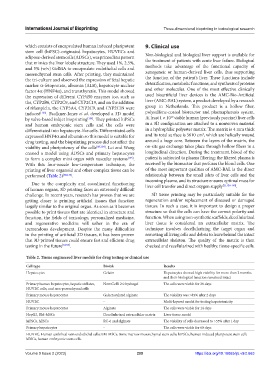
            performed (Table 2) [88,135] .                     relationship between the small islets of liver cells and the
                                                               incoming plasma, and its structure ensures optimal mass for
              Due to the complexity and coordinated functioning   liver cell transfer and direct oxygen supply [21,136-140] .
            of human organs, 3D printing faces an extremely difficult
            challenge. In recent years, research has proven that we are   3D tissue printing may be particularly suitable for the
            getting closer to printing artificial tissues that function   regeneration and/or replacement of diseased or damaged
            largely similar to the original organ. As soon as it becomes   tissues. In such a case, it is important to design a proper
            possible to print tissues that are identical in structure and   structure so that the cells can have the correct polarity and
            function, the fields of toxicology, personalized medicine,   function. When using non-synthetic scaffolds, decellularized
            and regenerative medicine will usher in the era of   liver tissue is considered an extracellular matrix. The
            tremendous development. Despite the many difficulties   technique involves decellularizing the target organ and
            in the printing of artificial 3D tissues, it has been proven   removing all living cells and debris to leave behind the intact
            that 3D printed tissues could ensure fast and efficient drug   extracellular skeleton. The quality of the matrix is then
            testing in the future [82,93] .                    checked and recellularized with healthy, tissue-specific cells.


            Table 2. Tissue engineered liver models for drug testing or clinical use
            Cell type                        Bioink                    Results
            Hepatocytes                      Gelatin                   Hepatocytes showed high viability for more than 2 months
                                                                       and their biological function remained intact
            Primary human hepatocytes, hepatic stellates,   NovoGelR 2.0 hydrogel  The cells were viable for 28 days
            HUVEC cells, and non-parenchymal cells
            Primary mouse hepatocytes        Galactosylated alginate   The viability was >85% after 2 days
            HUVEC                            -                         Multi-layered model for testing hepatotoxicity
            Primary mouse hepatocytes        Alginate                  The cells were viable for 14 days
            HepG2, BM-MSCs                   Decellularized extracellular matrix  Liver tissue model
            hiPSCs, hESCs                    RC-6 and alginate         The viability of cells decreased to >55% after 1 day
            Primary hepatocytes              -                         The cells were viable for 60 days
            HUVEC, Human umbilical vein endothelial cells; BM-MSCs, Bone marrow mesenchymal stem cells; hiPSCs, human induced pluripotent stem cell;
            hESCs, human embryonic stem cells.


            Volume 9 Issue 2 (2023)                        209                      https://doi.org/10.18063/ijb.v9i2.663

