


Page 218 - IJB-9-2
P. 218
International Journal of Bioprinting                       Three-dimensional bioprinting in toxicological research


            These are the first steps in creating transplantable liver grafts   10. Challenges and perspectives
            that can be implanted back into the patient.
                                                               Stem cells derived from the embryonic connective tissue
              Another artificial liver tissue graft, the mini-liver, may also   of mesoderm origin, that is, mesenchyme, do not have the
            be suitable for tissue regeneration or replacement. During the   ability to form gametes, but being multipotent cells, they
            creation of the mini-liver, a 3D structure was created using   are able to differentiate into many different cell types within
            a hydrogel and then implanted into nude mice after partial   the body. In humans, they are found in the bone marrow
            liver resection and radiation-induced liver damage. Mice   and non-marrow tissues such as placenta, umbilical cord,
            were divided into four groups: control, hydrogel, hydrogel   adipose tissue, muscle tissue, corneal stroma, and dental
            with HL-7702, and hydrogel with HGF. It was found that the   pulp of deciduous teeth. In addition to tissue formation,
            hydrogel did not reduce viability and did not interfere with   these stem cells are involved in tissue regeneration and
            cellular functions, and after implantation of the hydrogel,   play a significant regulatory role in inflammation and
            which also contained hepatocytes, liver regeneration was   carcinogenesis. Taking advantage of this ability, they are
            enhanced and the individuals showed longer survival times.  suitable to be used for therapeutic purposes and in the field
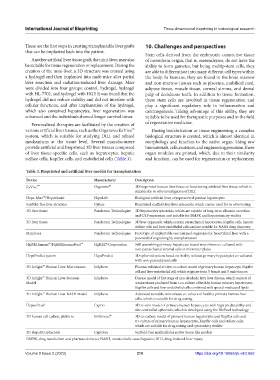
              Personalized therapies are facilitated by the creation of   of regenerative medicine.
            various artificial liver tissues, such as the Organovo ExVive    During biofabrication or tissue engineering, a complex
                                                         ™
            system, which is suitable for studying DILI and related   biological structure is created, which is almost identical in
            mechanisms at the tissue level. Several manufacturers   morphology and function to the native organ. Using raw
            provide artificial and bioprinted 3D liver tissues composed   biomaterials, cells, matrices, and engineering precision, these
            of liver tissue-specific cells, such as hepatocytes, hepatic   organ modules are printed, which, due to their similarity
            stellate cells, Kupffer cells, and endothelial cells (Table 3).  and function, can be used for regeneration or replacement


            Table 3. Bioprinted and artificial liver models for transplantation
            Device                       Manufacturer      Description
            ExVive ™                     Organovo ®        3D bioprinted human liver tissue or functioning artificial liver tissue, which is
                                                           suitable for in vitro investigation of DILI
                   ™
            Hepa-Mate /HepatAssist       HepaLife          Biological artificial liver, cryopreserved porcine hepatocytes
            Scaffold-free liver structure  Cyfuse          Bioprinted scaffold-free liver spheroids, which can be used for in vitro testing
            3D liver tissue              Pandorum Technologies  3D hepatocytes spheroids, which are capable of long-term albumin secretion
                                                           and CYP expression and suitable for DMPK and hepatotoxicity studies
            3D liver tissue              Pandorum Technologies  3D liver organoids, which contain parenchymal hepatocytes, Kupffer cells, hepatic
                                                           stellate cells and liver endothelial cells and are suitable for NASH drug discovery
            Mini liver                   Pandorum Technologies  Prototype of implantable vascularized organoids for bioartificial liver with a
                                                           potential of engrafting by transplantation
            HμRELhuman /HμRELhumanPool ™  HμREL  Corporation  Self-assembling primary hepatocyte-based microlivers co-cultured with
                                              ®
                      ™
                                                           non-parenchymal stromal cells in microtiter plates
            HepaPredict system           HepaPredict       3D spheroid system based on freshly isolated primary hepatocytes co-cultured
                                                           with non-parenchymal cells
            3D InSight  Human Liver Microtissues  InSphero  Pharma-validated in vitro co-culture model of primary human hepatocyte, Kupffer
                   ™
                                                           cell and liver endothelial cell, which originate from 5 female and 5 male donors
            3D InSight  Human Liver Steatosis   InSphero   Disease model of first stage of non-alcoholic fatty liver disease, which consists of
                   ™
            Model                                          a microtissue produced from a co-culture of healthy human primary hepatocytes,
                                                           Kupffer cells and liver endothelial cells combined with special media and lipids
            3D InSight  Human Liver NASH Model  InSphero   Advanced tuneable microtissue co-culture of healthy primary human liver
                   ™
                                                           cells, which is suitable for drug testing
            HepatoPearl                  Cyprio            3D in vitro model of primary human hepatocytes with high predictability and
                                                           size-controlled spheroids, which is developed using the BioPearl technology
            3D human cell culture platform  Invitrocue ®   3D co-culture model of primary human hepatocytes and Kupffer cells and
                                                           tri-culture of primary human hepatocytes, Kupffer cells and stellate cells,
                                                           which are suitable for drug testing and cytotoxicity studies
            3D HepaRG spheroids          Cyprotex          Scaffold-free multicellular native tissue-like models
            DMPK, drug metabolism and pharmacokinetics; NASH, nonalcoholic steatohepatitis; DILI, drug-induced liver injury.


            Volume 9 Issue 2 (2023)                        210                      https://doi.org/10.18063/ijb.v9i2.663

