


Page 407 - IJB-9-2
P. 407
International Journal of Bioprinting                   3D-printed skin substitute accelerates wound healing in vivo


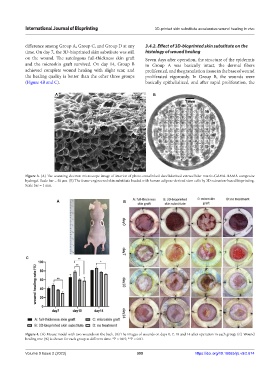
            difference among Group A, Group C, and Group D at any   3.4.2. Effect of 3D-bioprinted skin substitute on the
            time. On day 7, the 3D-bioprinted skin substitute was still   histology of wound healing
            on the wound. The autologous full-thickness skin graft   Seven days after operation, the structure of the epidermis
            and the microskin graft survived. On day 14, Group  B   in Group  A was basically intact, the dermal fibers
            achieved complete wound healing with slight scar, and   proliferated, and the granulation tissue in the base of wound
            the healing quality is better than the other three groups   proliferated vigorously. In Group  B, the wounds were
            (Figure 4B and C).                                 basically epithelialized, and after  rapid  proliferation,  the

                         A                                        B


            Figure 3. (A) The scanning electron microscope image of interior of photo-crosslinked decellularized extracellular matrix-GelMA-HAMA composite
            hydrogel. Scale bar = 50 μm. (B) The tissue-engineered skin substitute loaded with human adipose-derived stem cells by 3D extrusion-based bioprinting.
            Scale bar = 1 mm.


                         A                           B


            C


            Figure 4. (A) Mouse model with two wounds on the back. (B) The images of wounds on days 0, 7, 10 and 14 after operation in each group. (C) Wound
            healing rete (%) is shown for each group at different time. *P < 0.05; **P < 0.01.


            Volume 9 Issue 2 (2023)                        399                      https://doi.org/10.18063/ijb.v9i2.674

