


Page 408 - IJB-9-2
P. 408
International Journal of Bioprinting                   3D-printed skin substitute accelerates wound healing in vivo


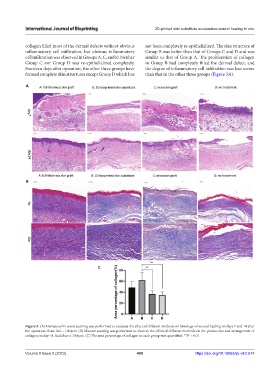
            collagen filled most of the dermal defects without obvious   not been completely re-epithelialized. The skin structure of
            inflammatory  cell  infiltration,  but  obvious  inflammatory   Group B was better than that of Groups C and D and was
            cell infiltration was observed in Groups A, C, and D. Neither   similar to that of Group A. The proliferation of collagen
            Group  C nor Group  D was re-epithelialized completely.   in Group B had completely filled the dermal defect, and
            Fourteen days after operation, the other three groups have   the degree of inflammatory cell infiltration was less severe
            formed complete skin structures except Group D which has   than that in the other three groups (Figure 5A).

            A


            B


                                           C


            Figure 5. (A) Hematoxylin-eosin staining was performed to evaluate the effect of different methods on histology of wound healing on days 7 and 14 after
            the operation. Scale bar = 100 μm. (B) Masson staining was performed to observe the effect of different methods on the production and arrangement of
            collagen on day 14. Scale bar = 100 μm. (C) The area percentage of collagen in each group was quantified. **P < 0.01.


            Volume 9 Issue 2 (2023)                        400                      https://doi.org/10.18063/ijb.v9i2.674

