


Page 406 - IJB-9-2
P. 406
International Journal of Bioprinting                   3D-printed skin substitute accelerates wound healing in vivo


            3.2. Preparation of dECM-GelMA-HAMA precursor      3.2.3. SEM imaging

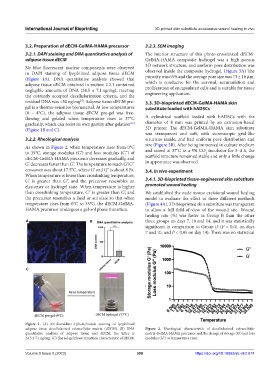
            3.2.1. DAPI staining and DNA quantitative analysis of   The  interior  structure  of this photo-crosslinked  dECM-
            adipose tissue dECM                                GelMA-HAMA composite hydrogel was a high porous
            No blue fluorescent nuclear components were observed   3D network structure, and uniform pore distribution was
            in DAPI staining of lyophilized adipose tissue dECM   observed inside the composite hydrogel. (Figure 3A) The
            (Figure  1A). DNA quantitative analysis showed that   porosity was 65% and the average pore size was 73 ± 18 μm,
            adipose tissue dECM obtained in section 2.2.1 contained   which is conducive for the survival, accumulation and
            negligible amounts of DNA (24.5 ± 7.1 ng/mg), meeting   proliferation of encapsulated cells and is suitable for tissue
            the currently accepted decellularization criteria, and the   engineering application.
            residual DNA was <50 ng/mg . Adipose tissue dECM pre-  3.3. 3D-bioprinted dECM-GelMA-HAMA skin
                                   [9]
            gel is a thermo-sensitive biomaterial. At low temperatures   substitute loaded with hADSCs
            (0 – 4°C), the adipose tissue dECM pre-gel was free-
            flowing and gelated when  temperature rises to 37°C   A cylindrical scaffold loaded with hADSCs with the
            gradually, which can resist its own gravity after gelation    diameter of 8  mm was printed by an extrusion-based
                                                        [10]
            (Figure 1B and C).                                 3D printer. The dECM-GelMA-HAMA skin substitute
                                                               was transparent and soft, with stereoscopic grid-like
            3.2.2. Rheological analysis                        structure inside, and had uniform pore distribution and
            As shown in Figure 2, when temperature rises from 0°C   size (Figure 3B). After being immersed in culture medium
            to 35°C, storage modulus (G’) and loss modulus (G’’) of   and stored at 37°C in a 5% CO  incubator for 3–4 h, the
                                                                                        2
            dECM-GelMA-HAMA precursor decreases gradually, and   scaffold structure remained stable and only a little change
            G’ decreases faster than G’’. The temperature to reach G’/G’’   in appearance was observed.
            crossover was about 17.5°C, where G’ and G’’ is about 8 Pa.   3.4. In vivo experiment
            When temperature is lower than crosslinking temperature,
            G’ is greater than G’’, and the precursor resembles an   3.4.1. 3D-bioprinted tissue-engineered skin substitute
            elastomer or hydrogel state. When temperature is higher   promoted wound healing
            than crosslinking temperature, G’’ is greater than G’, and   We established the nude mouse excisional wound healing
            the precursor resembles a fluid or sol state so that when   model to evaluate the effect of three different methods
            temperature rises from 0°C to 35°C, the dECM-GelMA-  (Figure 4A). 3D-bioprinted skin substitute was transparent
            HAMA precursor undergoes a gel-sol phase transition.  to allow a full field-of-view of the wound site. Wound
                                                               healing rate (%) was faster in Group  B than the other
            A                          B                       three groups on days 7, 10 and 14, and it was statistically
                                                               significant in comparison to Group D (P < 0.01 on days
                                                               7 and 10, and P < 0.05 on day 14). There was no statistical


            C


            Figure  1. (A) 4’,6-diamidino-2-phenylindole  staining of lyophilized
            adipose tissue decellularized extracellular matrix (dECM). (B)  DNA   Figure  2. Rheological  characteristic  of decellularized extracellular
            quantitative analysis of adipose tissue and dECM, the latter is   matrix-GelMA-HAMA precursor and the change of storage (G’) and loss
            24.5 ± 7.1 ng/mg. (C) The sol-gel phase transition characteristic of dECM.  modulus (G’’) as temperature rises.


            Volume 9 Issue 2 (2023)                        398                      https://doi.org/10.18063/ijb.v9i2.674

